Complete Guide to Cold Storage Energy Management
Cold storage energy costs stay high because refrigeration runs around the clock, so operators need to know what drives the spend and how to cut it safely.
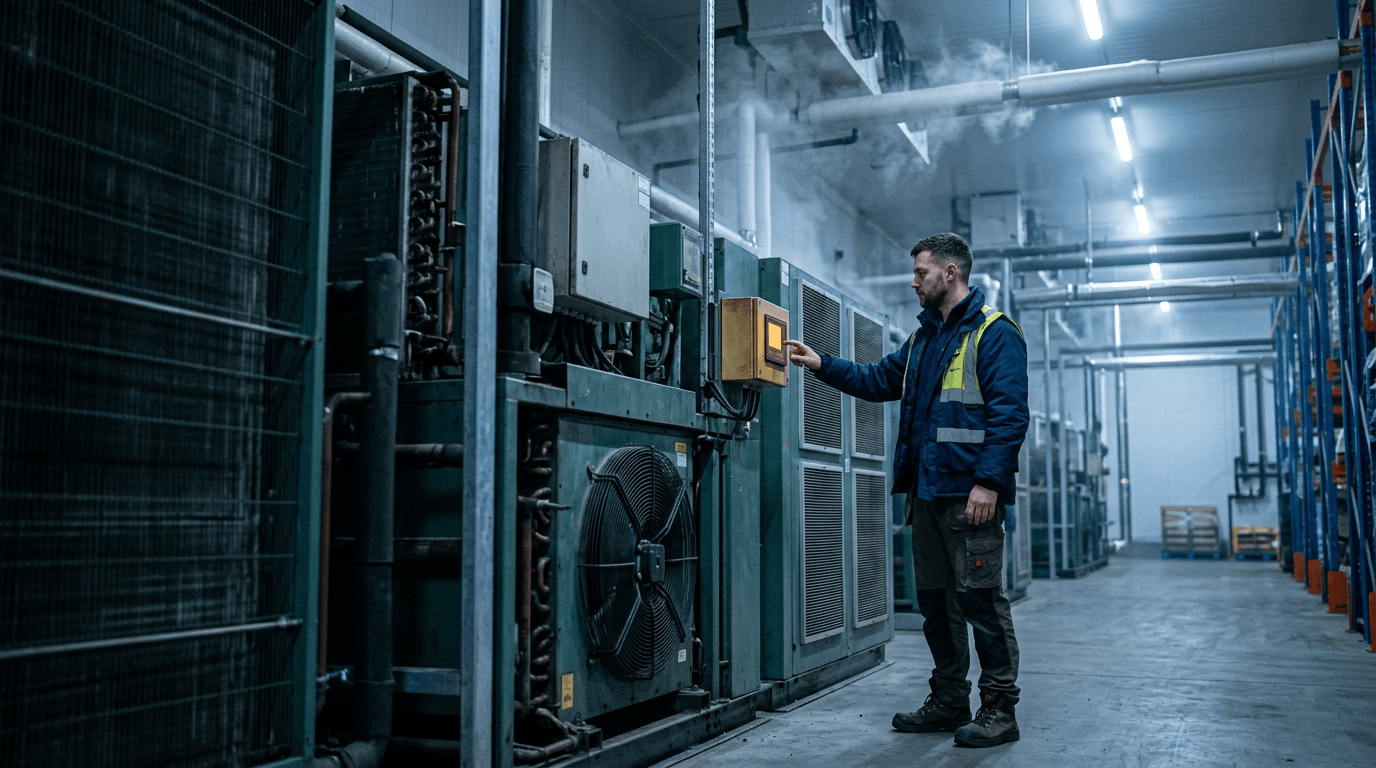
Cold storage energy costs stay stubbornly high for one reason: refrigeration never stops. A refrigerated warehouse runs its cooling systems around the clock to hold product at low temperatures that cannot drift even for an hour.
That constant duty makes energy the second-largest expense after labor costs at most cold storage facilities. The real challenge is holding energy costs down without risking temperature, product, or compliance.
What Drives Energy Consumption in Cold Storage Facilities
Refrigeration accounts for the largest share of energy consumption in cold storage facilities. Refrigeration systems draw the majority of a facility's electricity, and a refrigerated warehouse uses far more power per square foot, based on federal energy consumption data from the EIA. Compressors and condensers reject heat as energy intensive operations, so small inefficiencies in these refrigeration systems waste a significant amount of excess energy.
Air Infiltration and Heat Transfer
Air infiltration is one of the largest hidden sources of energy loss in cold storage. Every time a dock door opens, warm air rushes in, adding heat that refrigeration systems must remove. Steps that minimize heat transfer, including work to improve insulation, seal gaps, and cut air leakage, lower the heat load and the energy loss that follows.
Peak Demand and Electricity Costs
Electricity costs depend not only on how much energy a facility uses, but when. Utility companies charge demand rates on the highest power draw in a period, so compressor cycling during peak demand periods can set an expensive charge and drive up cooling costs annually. For cold storage operations, managing peak demand, often through demand response programs, is the largest controllable cost.
Energy Efficiency Upgrades: Solar, Battery Storage, and LED Lighting
Most cold storage companies already invest in the conventional playbook to improve energy efficiency:
- LED lighting with motion sensors cuts power and the heat it adds, and LED lighting runs well in low temperatures.
- Variable speed drives trim compressor and fan energy, and more variable speed drives cut further.
- Better insulation and high-efficiency energy-efficient refrigeration equipment reflect efforts to improve insulation that let the plant use less energy.
- Solar panels feed on-site solar energy against grid draw, and more solar panels raise solar generation.
- Battery storage systems pair with solar energy to add energy storage and battery storage that shift load off peak, while renewable energy sources and other renewable energy cut reliance on fossil fuels.
- Inflation Reduction Act incentives help fund this renewable energy, more solar energy, and other renewable energy sources.
A formal energy audit from ENERGY STAR helps prioritize these energy efficient solutions. These upgrades matter, yet hardware alone does not hold the savings, because efficiency is a moving target that never stays fixed.
Why Energy Efficiency Gains Fade Over Time
Energy efficiency gains fade because refrigeration performance drifts, and almost nothing tells the operator it is happening. A facility gets a temperature alarm the moment product is at risk. No alarm ever fires to say the plant runs 8% less efficient than it did 60 days ago. Fouled condensers, drifting calibration, ice buildup, and refrigeration settings nudged during a busy shift quietly raise energy usage while every temperature reading stays in range.
Without real time monitoring of efficiency itself, this energy waste hides in plain sight. Cutting it is a detection problem first, so continuous measurement, not another retrofit, protects the energy savings a cold storage facility already paid for.
Optimizing Energy Efficient Operations Without Risking Temperature
The real ceiling on energy efficient operations is fear, and it is rational. Aggressive setpoints, floating head pressure, and load shifting all save energy, but pushed too far they threaten the low temperatures that keep product safe. Most teams at cold storage facilities leave savings on the table because they cannot test a change with confidence, and one temperature excursion costs more than a year of efficiency gains.
Safe optimization depends on hard boundaries. When a system models a change against a facility's real behavior before it executes, and holds every adjustment inside compliance and temperature guardrails, operators gain both savings and operational reliability. Cutting energy expenses safely means pushing refrigeration toward energy efficient operation without crossing the line that protects the product, even during power outages.
Standardizing Energy Savings Across the Cold Storage Industry
Across the cold storage industry, the biggest savings leak has nothing to do with hardware. Improvements simply do not travel. A champion proves a smart control strategy at one site, the bill drops, and the gain never reaches the other 40 cold storage facilities because no two sites run the same way. Effective strategies stay trapped as tribal knowledge.
Treating energy as a portfolio governance problem changes this. When leadership standardizes the winning strategy across every site with permissioned control, improvements compound and operational efficiency rises instead of resetting.
Nick Green of Americold frames the goal as corporate visibility: getting "all of our sites and all of our systems onto one platform" to standardize and see performance clearly. Eric Krupa of Lineage describes the payoff across nearly 480 cold storage facilities, where one platform gives operators a "common look and feel." Operators taking this path appear in these real-world cold storage energy savings.
Request a demo to see portfolio-wide energy performance in one view.
Cutting Cold Storage Energy Costs Safely and at Scale
Four moves do this safely:
- Measure efficiency continuously.
- Detect drift early.
- Optimize inside safety guardrails.
- Standardize across the portfolio.
ATLAS from CrossnoKaye sits on top of existing OEM controls without rip-and-replace, so cold storage facilities keep their refrigeration technology and gain a governed layer that executes, not just monitors.
The Energy AI App applies advanced process control and real time monitoring to run each site against live utility rates, weather, and load, delivering continuous energy optimization for cold storage that holds. It also turns refrigeration systems into a grid asset through automated demand response and utility demand response programs, trimming peak demand without staff on site. Nick Weaver of US Foods puts it plainly: "we no longer go on site for any of them. It's a hands-off demand response." Customers see an average 21% cut in energy costs, embedded through new technologies rather than bolted on.
Lower Energy Costs and Carbon Emissions
Lower energy costs and lower carbon emissions move together. Every kilowatt-hour a facility avoids trims the bill and its carbon footprint, so reducing carbon emissions and shrinking environmental impact become direct results of disciplined energy management.
Contact CrossnoKaye to map energy savings across your portfolio.
Frequently Asked Questions
What is the impact of rising energy prices on cold chain logistics?
Rising energy prices hit cold chain logistics especially hard because refrigeration is a fixed, around-the-clock load that cannot be switched off to save money. As electricity costs climb, that energy intensive base load raises operational costs and energy consumption across storage and distribution and ripples into the wider food sector and global economy. It pushes cold storage operators toward active energy management.
What is kW per ton, and why does it matter for cold storage energy costs?
kW per ton measures how much electricity a refrigeration system uses to remove a set amount of heat, making it the clearest gauge of cold storage energy efficiency. Tracking it over time exposes the efficiency drift that temperature readings hide, so a rising number signals wasted energy usage before the bill arrives. It turns energy conservation into something measurable.
Can cold storage facilities cut energy costs without replacing refrigeration equipment?
Yes. The capital cost and downtime of new equipment are avoidable, because cold storage facilities can cut energy costs by governing the refrigeration equipment already in place rather than replacing it. Standardizing energy efficient operation across sites is a practical way to improve energy efficiency and improve operational efficiency with existing equipment.

Stay Connected
Subscribe to stay in the loop on the latest industry news.
Related Posts
.png)