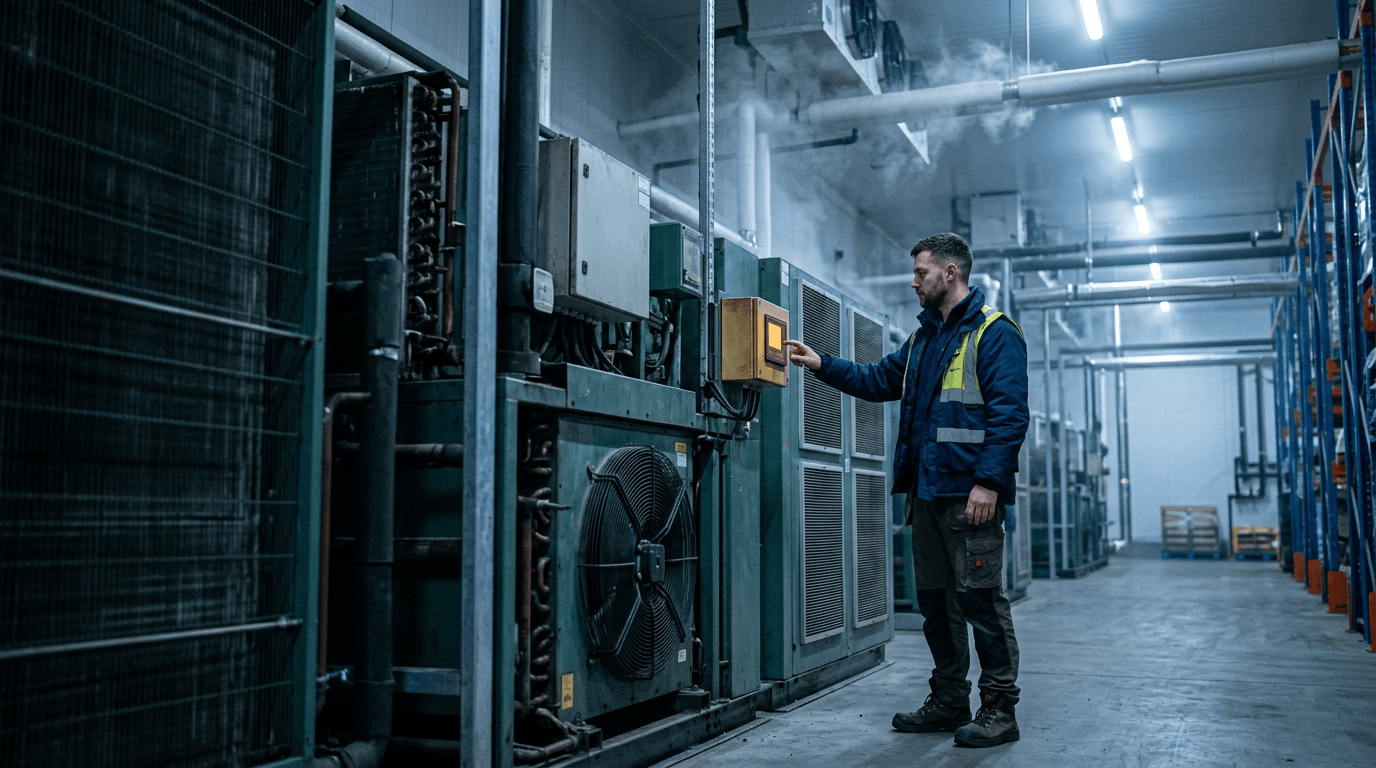
Industrial Monitoring: What It Is, Benefits & How It Works
What is industrial monitoring, how does remote equipment monitoring work, and what are the benefits? Learn everything you need to know.

Most industrial operations teams know something is wrong before they can prove it.
A compressor running hotter than usual. Energy consumption creeping up month over month. An alarm that fires at 2 a.m. with no obvious cause.
These signals exist in every facility. The question is whether your systems are built to catch them early, or whether you find out after the damage is done.
Industrial monitoring is the practice of continuously collecting, analyzing, and acting on data from industrial equipment, production processes, and facility systems. In complex, multi-site environments, it's often the difference between a five-minute remote diagnosis and a six-hour emergency callout.
This article covers:
- What industrial monitoring is and how it works
- The key components of an industrial monitoring system
- Common use cases across industrial operations
- The benefits of real-time monitoring for multi-site teams
- How to implement a remote monitoring system in an existing facility
- Where AI and advanced process control are taking the practice next
What Is Industrial Monitoring?
Industrial monitoring is the continuous collection and analysis of operational data from industrial equipment, production processes, and facilities to detect anomalies, track performance, and support faster decision-making.
A well-designed remote monitoring system pulls data from sensors, controllers, and connected assets. Then, it surfaces actionable insights so teams can:
- identify equipment issues,
- verify system health,
- support quality control processes,
- ensure safety, and
- take action without waiting for something to fail.
In practice, industrial remote monitoring spans many industries: cold storage and industrial refrigeration, food processing, manufacturing, and other industrial applications across utilities and any sector where equipment health directly affects product quality, operating costs, or efficiency.
Across these industrial applications, the ability to remotely monitor production lines, factory floor assets, and remote locations from a single platform is what separates reactive operations from proactive ones.
It is worth drawing a distinction that often gets lost in vendor conversations. Monitoring and control are not the same thing. Monitoring tells you what is happening. Control lets you do something about it.
The most capable platforms today combine both, giving teams not just visibility into asset state, but the ability to act on that data with permissioned, auditable control from wherever they are; the hallmark of comprehensive monitoring solutions designed for enterprise deployments.
How Does Industrial Remote Monitoring Work?
Industrial remote monitoring works by connecting physical assets to a software layer that collects, transmits, and analyzes operational data in real time. Understanding this architecture helps operations leaders evaluate monitoring solutions more accurately and avoid platforms that display data without enabling action.
IoT devices and sensors capture raw data at the asset level:
- temperature
- pressure
- vibration
- energy consumption
- flow rates
- motor speed
- and other operating parameters.
Modern deployments use a combination of wired sensors on critical assets and wireless sensors on assets where cabling is impractical, feeding continuous streams of operational data into the remote monitoring platform.
That data travels through PLCs (programmable logic controllers) and, in modern deployments, edge computing nodes that handle local processing before sending structured data to the cloud. That upward path follows the layered structure of the Purdue Model, which separates field devices, basic control, and supervisory systems from the business network above them. This edge computing layer is what makes low-latency remote monitoring viable even in facilities with constrained network connectivity, a tradeoff explained in more detail in this guide to edge vs. cloud analytics for industrial equipment.
Communication protocols like OPC UA standardize how data moves from field devices to upstream systems, a data acquisition layer that provides a consistent model regardless of manufacturer or vintage. This matters significantly in facilities with aging infrastructure, where legacy control hardware has often been customized over years of site-specific operation.
At the cloud or platform layer, data is aggregated, stored as historical data, and made available for analysis. Alarm logic fires when readings cross defined thresholds or when the remote monitoring platform detects patterns that deviate from expected behavior. Relevant personnel can log in, review current system state, drill into equipment health trends, and (in platforms with genuine control authority) initiate supervisory control actions without being on site.
Security is a practical concern at every layer of this stack. SOC 2 compliance, end-to-end encryption, and role-based access controls are baseline expectations for any enterprise deployment; governing not just who can see data, but who can change what, and creating an audit trail of every action taken.
Key Components of an Industrial Monitoring System
A functional remote monitoring system is built from several interdependent components. Understanding each layer helps operations leaders evaluate platforms more accurately and avoid buying visibility they cannot act on.
Below is table on the key components of an industrial monitoring system:
IoT devices and sensors capture raw data at the asset level: temperature, pressure, vibration, energy consumption, flow rates, motor speed, and other operating parameters — the building blocks of Industrial IoT (IIoT) covered in more depth elsewhere.
The Gap Between Visibility and Resolution
The most common misconception about remote monitoring is that visibility is the finish line. It is not. Seeing that a system is degrading and being able to do something about it quickly are two very different capabilities, and the distance between them is where downtime, energy waste, and regulatory compliance risk actually live.
Consider how most reactive response cycles unfold.
An alarm fires. Someone investigates, often with partial context and no remote access to the monitoring system. They call in an expert, who may not be available until the following morning. By the time the right person has the right access, what started as a recoverable anomaly has escalated. The monitoring system did its job. Everything after it failed.
This is the practical case for combining remote monitoring with governed control authority. When the same platform that surfaces an issue also allows a qualified technician to diagnose and resolve it remotely, with the right permissions, without bypassing safety constraints, the gap between detection and resolution collapses.
That shift in response time is measurable: ATLAS platform users resolve an average of 15 to 20 issues per month remotely that would otherwise require an on-site visit, reducing both service calls and personnel time spent traveling between locations.
Common Use Cases for Industrial Monitoring
Industrial monitoring serves several distinct operational needs, each with a different trigger, a different set of stakeholders, and a different measure of success. Understanding which use cases apply shapes what the remote monitoring platform needs to do.
Benefits of Real-Time Industrial Monitoring for Operations Teams
The operational benefits of real time monitoring become most visible when measured against the actual cost of the status quo: unplanned downtime, after-hours contractor calls, and energy consumption that nobody can fully explain.
Faster Issue Detection
A remote monitoring system that continuously analyzes asset health data catches degradation patterns before they produce failures, giving teams a window to respond during normal working hours rather than in a crisis.
ATLAS users report a 20% reduction in after-hours contractor calls; a direct result of catching potential equipment breakdowns earlier and resolving them remotely before they escalate.
Reduced Downtime
When technicians can log in, diagnose a problem, and make a change without traveling to a facility, the cycle time from detection to resolution drops significantly. Remote monitoring systems that surface early degradation signals allow teams to reduce downtime before it materializes, scheduling repairs around production rather than reacting to them, directly reducing costs and production losses associated with unplanned outages.
For multi-site operators, the cumulative effect on maintenance costs and response time is substantial.
Energy Cost Reduction
Without real time monitoring of system performance, production lines, and utility consumption, energy strategies rely on estimates and manual audits. With it, teams gain real time insights to identify inefficiencies, respond to utility rate signals, and verify that efficiency improvements are holding over time.
The EPA's ENERGY STAR program offers industrial energy performance indicators that reinforce why baseline measurement and real time data are the prerequisites to any meaningful efficiency program.
Industrial operations that reduce downtime and reduce costs through monitoring investments consistently outperform those relying on reactive approaches.
Portfolio-Wide Standardization
When every facility runs on a common industrial monitoring and control platform and reports into a shared data environment, corporate teams can compare performance insights across locations, identify outliers, and push operational improvements across the entire portfolio rather than one site at a time.
Ready to see what real-time visibility looks like across your facilities? Request a demo of the ATLAS Enterprise Control Platform.
Industrial Monitoring at Portfolio Scale: Where Most Monitoring Solutions Fall Short
Monitoring a single facility is a solved problem. The harder challenge, and the one that matters most to enterprise operations leaders, is governing performance across a portfolio of dozens or hundreds of facilities where no two sites are identical and production processes vary significantly.
The Portfolio Problem: No Two Sites Are the Same
Eric Krupa, Global Engineering and Maintenance Leader at Lineage Logistics, described the challenge directly when discussing ATLAS across Lineage's nearly 480 facilities worldwide: the goal is to consolidate, standardize, and then optimize, and getting a common look and feel across monitoring systems and control infrastructure is foundational to that ambition.
Without a shared remote monitoring system, every site operates as its own snowflake, carrying its own configurations, alarm definitions, and operator workarounds.
What Portfolio-Level Monitoring Actually Unlocks
Nick Green, Senior Manager of R&E at Americold, experienced what portfolio-level remote monitoring unlocks in a tangible way: when a major heat wave event created grid stress, Americold's ability to respond through a unified industrial remote monitoring system delivered $600,000 in savings from a single event.
That outcome required not just monitoring assets, but the ability to act on what the data showed, simultaneously across multiple facilities, with appropriate governance in place.
Why Governed Control Is the Real Differentiator
This is where governed control becomes the differentiator. Permissioned access determines who can initiate changes at which facilities. An audit trail captures every action, by whom, and when.
Corporate leadership retains oversight without micromanaging individual sites. And when something needs to change, it can be deployed across the entire portfolio from a single interface rather than scheduled as a series of site-by-site projects.
The International Institute of Ammonia Refrigeration (IIAR) sets safety and operational standards for industrial refrigeration environments (iiar.org), the kind of regulatory compliance visibility that portfolio-level remote monitoring makes auditable rather than assumed.
How to Implement an Industrial Monitoring System in an Existing Facility
Implementation does not require replacing existing infrastructure. The majority of industrial operations run on control hardware that has been in place for years or decades.
PLCs, HMIs, and site-specific control systems that have been customized by the teams who built and maintain them. A well-designed industrial remote monitoring platform layers on top of that infrastructure rather than displacing it.
The practical starting point is assessing what data is already available. Most facilities have more instrumentation than their teams actively use. The challenge is connecting it to a monitoring system that can aggregate and analyze it at the platform level.
An inventory of existing PLCs, control systems, IoT devices, and sensor coverage reveals where the gaps are before deployment. For factory floor environments, understanding current data acquisition capability informs the scope of any additional instrumentation needed.
From there, the implementation sequence generally follows:
- Establish connectivity between field hardware and the remote monitoring platform
- Configure alarm logic and operational thresholds based on the facility's specific systems and operating requirements
- Define user roles and access permissions
- Validate that information flowing into the remote monitoring platform accurately reflects actual system state and production processes.
Adoption planning, including role clarity, permissions structures that ensure safety and compliance, and worker safety protocols, is as important as the technical deployment. The teams using the platform day-to-day need to understand what it shows them, trust that it reflects reality, and know what actions they are authorized to take.
Platforms built around permissioned supervisory control make this explicit rather than leaving it to informal norms, which is especially important when asset tracking and remote monitoring responsibilities span multiple sites and contractors.
CrossnoKaye's approach to implementation is designed for exactly this kind of environment. See how facility teams across industrial sectors have navigated this transition, from initial deployment through portfolio-scale expansion.
The Role of AI and Advanced Analytics in Modern Industrial Remote Monitoring
The next meaningful shift in industrial remote monitoring is already underway. Continuous data collection and anomaly detection are table stakes. The platforms that will define the next decade combine that foundation with AI-driven advanced analytics and process control that does not just observe but acts.
Predictive Maintenance
By analyzing patterns in asset performance data over time, AI models can identify the early signatures of component degradation, helping teams detect anomalies and prevent potential equipment failures before they surface as alarms.
The shift from time-based preventive maintenance to condition-based maintenance reduces unnecessary work, extends asset life, and gives teams the ability to schedule maintenance based on actual equipment state rather than fixed intervals.
The result is a meaningful reduction in both maintenance costs and production issues caused by unplanned outages.
Automated Energy Optimization
Physics-based machine learning models that understand both internal system state and external variables like utility rates, weather, and environmental conditions can dynamically adjust production processes to minimize energy spend without compromising product quality or worker safety.
For many industries managing large-scale refrigeration or process cooling, this represents a shift from reactive energy management to a genuinely proactive approach, the same shift detailed in this guide to cold storage energy management. An AI-driven remote monitoring platform operating within defined safety guardrails provides the efficiency benefits of automation while upholding the regulatory compliance controls that industrial environments require.
Continuous Platform Improvement
For operations leaders evaluating what comprehensive monitoring solutions built on AI actually deliver, the underlying architecture matters.
Platforms built on modern cloud infrastructure can push capability updates across an entire portfolio simultaneously, meaning the AI models and optimization logic improve continuously rather than requiring site-by-site reengineering every time something changes.
Frequently Asked Questions
What is the difference between industrial monitoring and industrial control?
Industrial monitoring collects and surfaces data about system state and production processes. Industrial control goes a step further by enabling authorized personnel to take action based on that data, adjusting process parameters, initiating load shifts, or resolving issues remotely. The most capable enterprise monitoring solutions combine both, providing 24/7 visibility and permissioned supervisory control authority in a single industrial remote monitoring system.
How does industrial remote monitoring reduce unplanned downtime?
Industrial remote monitoring reduces unplanned downtime by catching anomalies earlier in their development, before they escalate into potential equipment failures. When teams have continuous visibility into equipment health and alarm data, and can remotely monitor that information from anywhere, they can diagnose and often resolve issues without waiting for an onsite response.
Earlier detection means more options: adjust a process parameter, dispatch a technician with the right parts, or schedule maintenance during a planned window rather than an emergency response. The result is a measurable reduction in both production issues and the maintenance costs associated with unplanned outages.
Is industrial remote monitoring software compatible with legacy assets?
Yes, in most deployments. Enterprise remote monitoring systems designed for complex industrial environments are built to integrate with existing PLCs, HMIs, and control systems rather than replace them, including aging refrigeration controls and site-specific automation hardware.
The practical requirement is that existing hardware supports standard communication protocols or can be connected through a gateway. A site audit prior to deployment will identify any compatibility gaps and determine whether additional instrumentation or connected devices are needed.
How is data security handled in cloud-based industrial remote monitoring platforms?
Enterprise-grade industrial remote monitoring platforms address security through a combination of technical controls and governance policies. SOC 2 compliance establishes baseline requirements for data handling and organizational security practices. End-to-end encryption protects data in transit and at rest.
Role-based access controls govern who can view production processes data and who can initiate changes, with every action logged for audit purposes. For IT and security teams evaluating these platforms, reviewing the vendor's SOC 2 report and understanding their IT/OT network segmentation approach are the right starting points.
What KPIs should an industrial monitoring system track?
The most operationally useful KPIs vary by facility type and business priority, but commonly include: asset uptime and mean time between failures, alarm frequency and time-to-resolution, energy consumption by system and by site, maintenance costs split between remote and onsite resolution, and temperature or process excursions by facility.
For operations teams managing environmental monitoring requirements, relevant KPIs also include environmental conditions thresholds, leak detection event frequency, and water quality or air quality readings. At the portfolio level, variance between sites on these metrics is often the most actionable signal, identifying which facilities are underperforming and where proven practices from high-performing sites can be replicated.
Visibility Is the Starting Point, Not the Destination
The case for industrial remote monitoring is straightforward: operations teams cannot manage what they cannot see. But the more important capability, the one that separates a basic monitoring solution from an enterprise control platform, is what happens after the data surfaces.
Whether teams can act on it quickly, from remote locations or on site, with the right permissions and a full audit trail, determines whether remote monitoring translates into actual operational efficiency or just a more detailed view of the same problems.
For multi-site operators managing portfolios of industrial facilities, the opportunity is larger than any single site improvement. Standardizing industrial processes and production processes across every location, meeting regulatory requirements uniformly, and deploying optimization at scale are the outcomes that justify the investment, and they require a comprehensive monitoring solution built for that purpose from the ground up.
Explore CrossnoKaye's industrial monitoring and control resources to go deeper on specific use cases, or reach out to the team to discuss what governed control looks like for your portfolio.
See ATLAS in action. Request a demo to walk through the platform with a CrossnoKaye engineer.
Stay Connected
Subscribe to stay in the loop on the latest industry news.
Related Posts
.png)