The Hour That Costs You: Why Rate Schedules Trip Up Even Great Teams
Utility rate schedules are easy to misread, and mistimed curtailment costs real money. See how automated control acts on the right hour, every time.

On July 28th, Georgia Power's real-time market rates spiked to $5.47/kWh—more than 130x the median peak rate on a typical day in 2026 ($0.041/kWh). This was one of three high-rate days in one week. For industrial facilities across the state, a few hours of load at the wrong time meant the kind of energy bill that gets everyone's attention.
Moments like this are supposed to be what curtailment plans are for. Watch the rates, shed load during the spike, ride it out. Simple on paper.
Here's what makes it hard in practice: utility rate schedules aren't written for the people who have to act on them. Georgia Power's real-time rates, for example, apply to the hour before the posted time — not after. Read the schedule the intuitive way, and you'll shed load at 4pm for a rate window that started at 3pm. Your team did everything right. The compressors came down on schedule. And the facility absorbed the spike anyway.
“Utility rate tariffs read like legal documents because they are legal documents. I read these for a living and still read them twice. Every ISO and utility defines timing differently—posted time versus effective time, which interval sets your demand charge. Those details can be the difference between a good month and a bad one. Expecting a plant team to interpret a tariff correctly at 3pm on a Tuesday while running a facility isn't realistic.”
– Jesse Tootell, Energy Partnerships Leader
The job nobody signed up for
Facility teams in cold storage and food distribution are already responsible for refrigeration performance, food safety, maintenance, staffing, and throughput. Energy strategy gets added to that list — usually without added headcount, training, or tools.
So curtailment decisions end up resting on a spreadsheet, a bookmarked utility page, and whoever happens to be watching. Even when the effort is there, the information often isn't. Rate structures change. Peak windows shift. And a schedule interpreted slightly wrong doesn't announce itself — the bill just comes in higher, and nobody knows why.
"The teams we work with care deeply about controlling energy spend. What they're missing isn't motivation — it's accurate, current information and the time to act on it. When your day is refrigeration, safety, and production, 'monitor the grid' is the task that always slips."
- Ivy Arkfeld, Product Success Manager at CrossnoKaye
At some point, more vigilance isn’t the answer. A better system is.
What last week looked like with ATLAS
During the Georgia Power spike, facilities across the state operating with ATLAS didn't wait for someone to notice the rates.
ATLAS carries the current rate structure for every facility it runs — including the fine print about when windows actually begin and end. It monitors grid conditions in real time. And when high-rate periods approach, it acts: pre-cooling ahead of the window to bank thermal capacity, then shedding load through the spike itself — safely, within the operating limits of each facility.
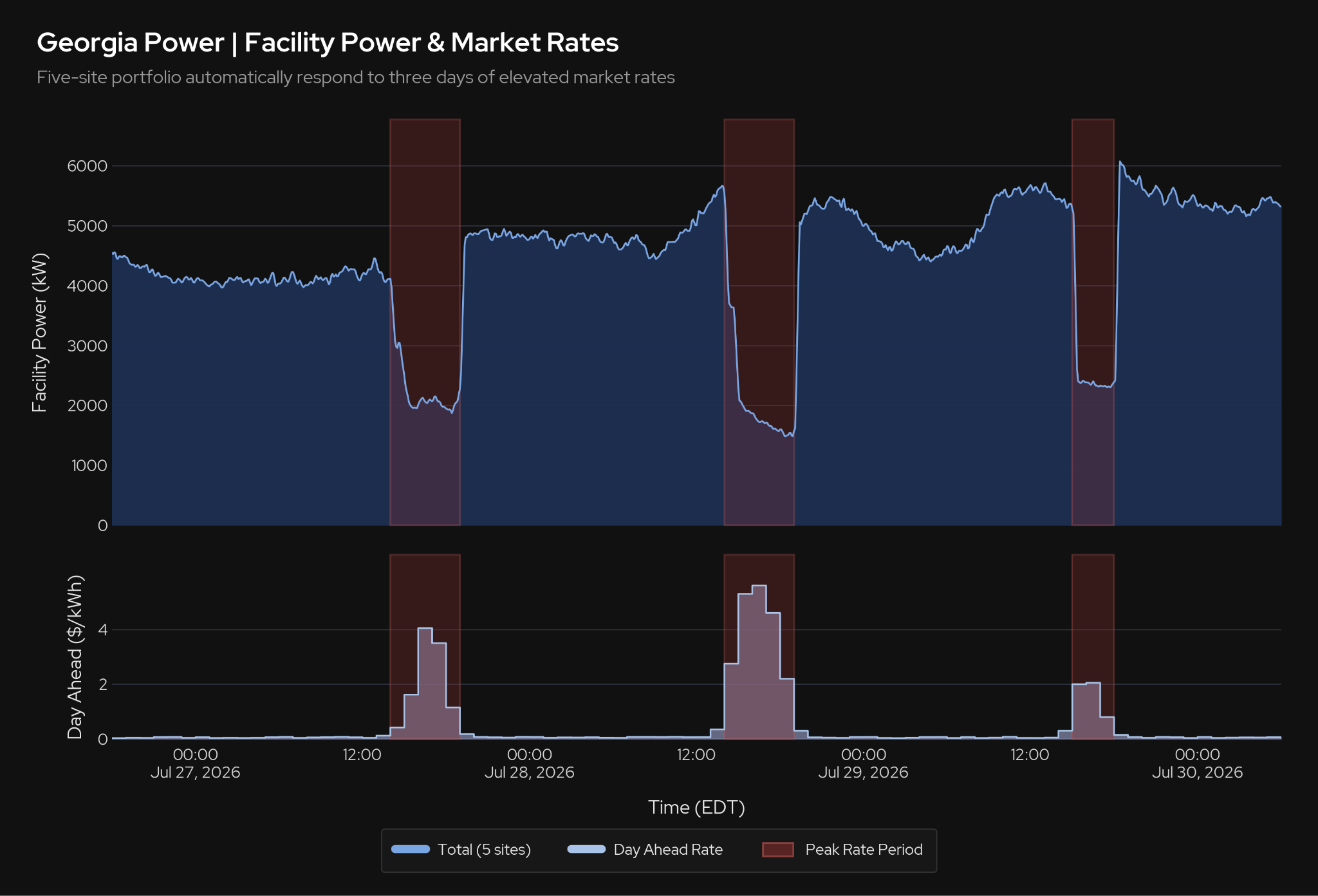
The portfolio data tells the story. In the hours before each high-rate window, you can see facilities ramp cooling up — the pre-cool. Then, as the window opens, load drops across the board and stays down until rates recover. No one on the plant floor had to interpret a tariff, watch a dashboard, or make a judgment call under pressure.
“ATLAS doesn’t wait for someone to read the tariff and build a response plan. When rates are expected to rise, it automatically re-forecasts each facility’s operating plan — determining when to pre-cool, how much load can safely come down, and when to recover critical process areas. Cooling and safety constraints stay built into every decision. Across Georgia last week, that meant one coordinated response to the utility price signal instead of a dozen judgment calls with inconsistent performance.”
- Silvestr Zhuk, Product Manager at CrossnoKaye
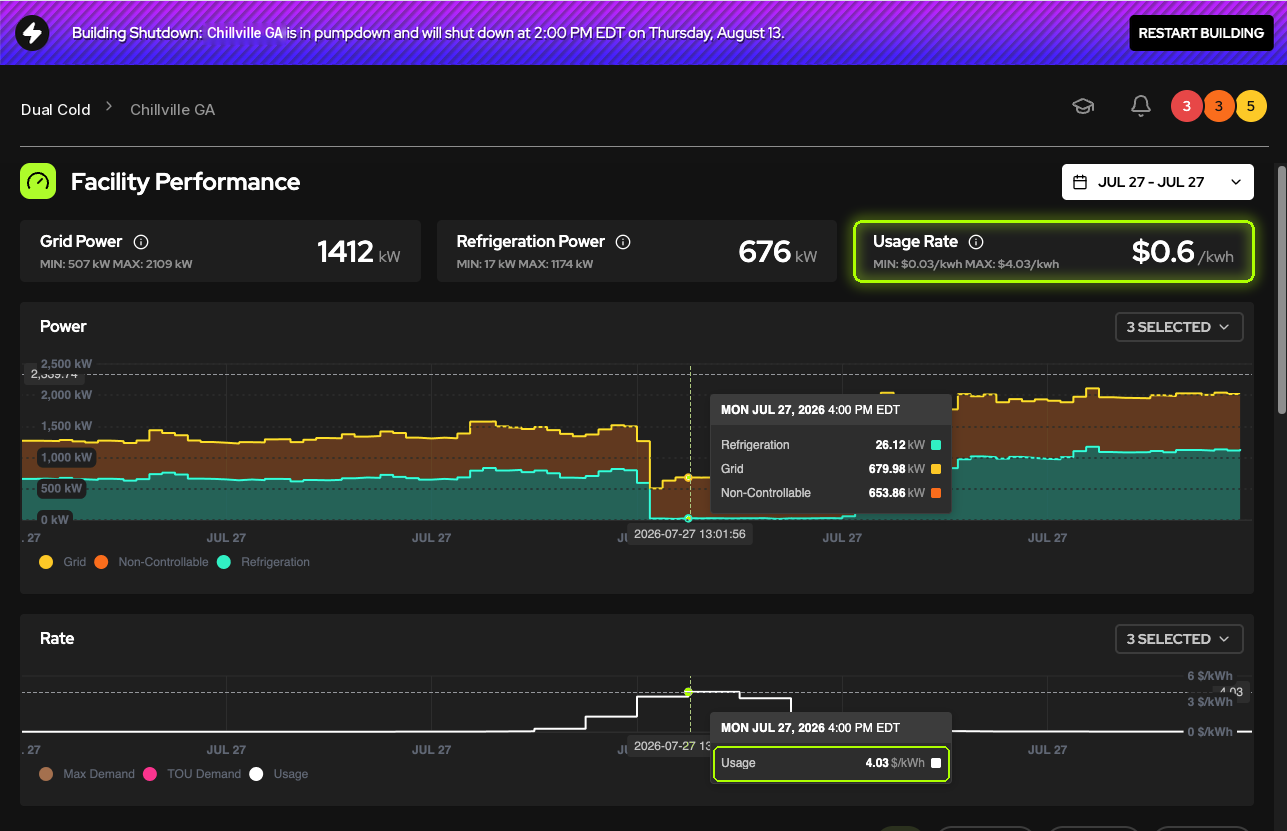
Timing is the whole game
Energy savings in industrial facilities shouldn’t be about heroic effort during a crisis. With automation facilities are able to act on accurate information at exactly the right moment — every time, at every site, without pulling anyone off the work they were actually hired to do.
“There’s a broader shift happening toward software-defined controls. As companies around the world realize the value of industrial AI and physical AI, that transition to software-defined automation is accelerating. Businesses are recognizing that their operating infrastructure can’t just execute a fixed set of rules — it needs to adapt as conditions change and as business requirements evolve. The companies investing in that flexibility now are building an advantage that compounds over time.”
- Jesse Crossno, Chief Product Officer and Co-Founder of CrossnoKaye
Last month it was Georgia Power at $5.47/kWh. Next month it'll be a shifted ERCOT peak or a PJM coincident-peak day. The rates will keep moving. The question is whether your facility moves with them.

Stay Connected
Subscribe to stay in the loop on the latest industry news.
Related Posts
.png)