Software-Defined Manufacturing: Preparing Controls for AI
Software-defined manufacturing wraps existing PLCs in a flexible control layer that AI can work with, while deterministic guardrails stay at the edge.
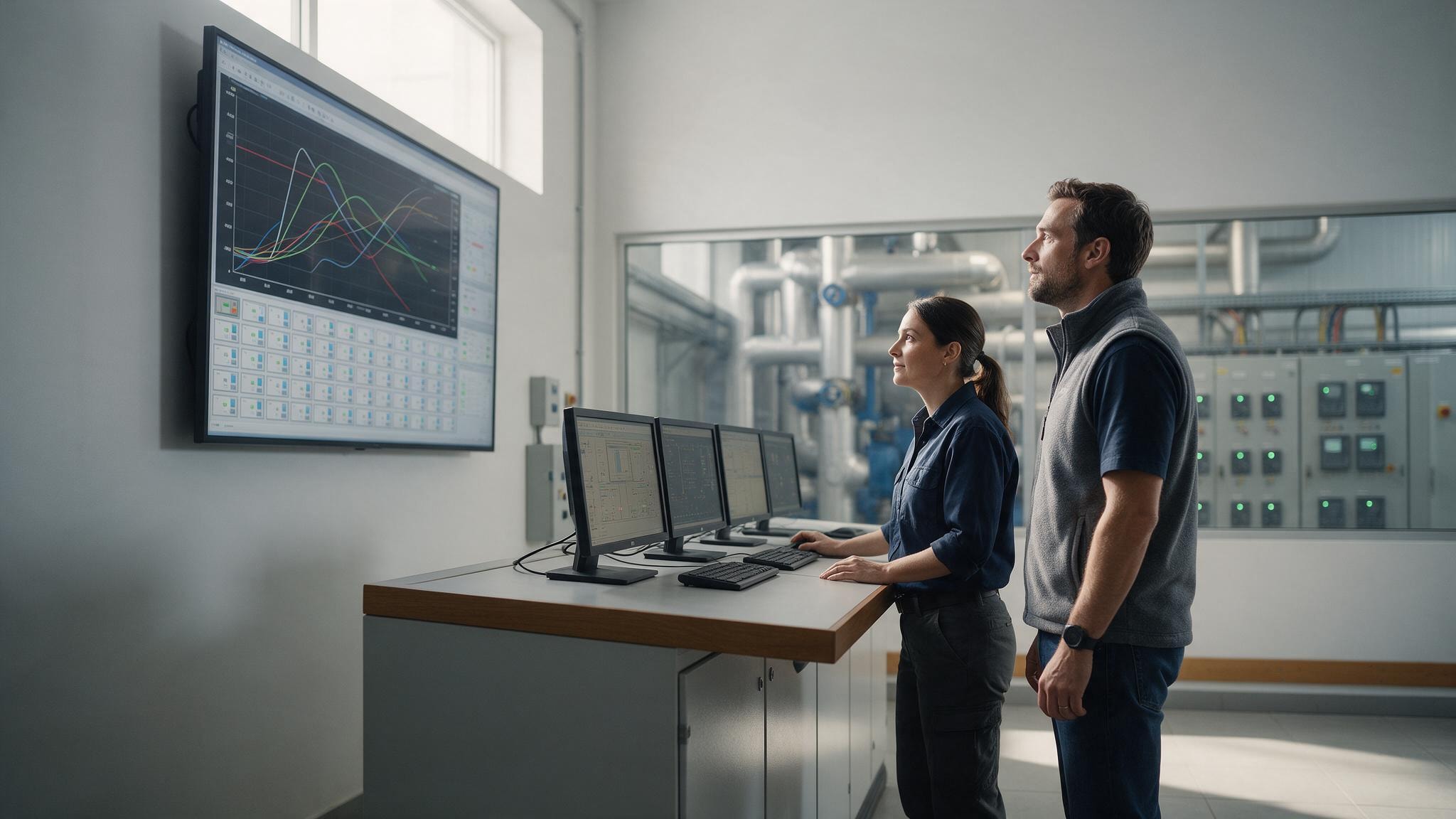
Software-defined manufacturing makes industrial operations AI-ready by using a software-defined automation platform to wrap existing PLCs and control systems in a centralized software layer that standardizes data and governs every change to control logic.
Industrial AI then recommends changes through that layer, operators decide which levers it can touch, and deterministic controls keep final authority at the equipment. The PLC stays in place. The plant just relies less on hand-edited logic inside each controller.
For food processing and cold storage operators, whether an AI pilot scales past one line or stalls at the first site depends on this architecture.
What Is Software-Defined Manufacturing?
Software-defined manufacturing is an approach where production systems are configured, controlled, and improved through software instead of changes to physical hardware. Fraunhofer IESE describes it as software-centered control and optimization of the manufacturing process.
In practice, software-defined automation is the full stack, software-defined controls are the edge piece of it where deterministic logic runs, and software-defined manufacturing is that platform applied to production
The model borrows from the software-defined everything movement in information technology, which splits the control plane (where decisions are made) from the data plane (where the work happens). A software-defined factory applies the same split to operational technology.
For the full mechanics, see how software-defined automation separates control logic from hardware.
Why Does Industrial AI Stall on the Traditional Factory Floor?
Industrial AI stalls when each site names and formats its data differently. In traditional manufacturing, control logic sits in proprietary software on individual controllers, and vendor-specific connectivity keeps each line's data in its own format. A machine learning model trained on one plant's real-time data can't read the next plant's without custom mapping.
Food processors see yield swings and unplanned downtime at every site but can't compare the causes, so lost production capacity stays unexplained. Change history is a second gap. If nobody can show who changed a setpoint and why, no one can trust an algorithm to change one either.
In a 2024 IoT Analytics survey of 500 manufacturers, 72% named scalability, the top tech stack priority for the next three to five years.
Three Layers That Make Factory Automation AI-Ready
An AI-ready software-defined architecture separates factory automation into three layers, each with a clear job and a hard limit.
Layer 1: Deterministic Control on the Factory Floor
PLCs and safety interlocks keep executing fast, predictable logic at the physical assets. Software-defined systems reduce reliance on hand-edited PLC code, while the interlock keeps the final word on system behavior. Brad Deemer describes an interlock as an edge-based deterministic guardrail that AI can’t override. IoT Analytics reported that virtual PLCs still had low maturity at the end of 2024, another reason to keep the physical controller in charge.
“You need deterministic guardrails at the edge. If a Waymo senses something in front of the car, it engages the brake, and no AI in the world can get it to keep accelerating. All AI can do is say, ‘I think you should accelerate.’ That is the exact parallel to a PLC interlock. An interlock is just an edge-based deterministic guardrail, and it always wins.”
- Brad Deemer, Principal Technical Product Manager at CrossnoKaye
Layer 2: A Centralized Software Layer for Governance
The centralized software layer is where industrial automation controls become governable across a portfolio. It acts as a configurable hub that normalizes tags from different OEM systems into one model and stores control logic as versioned strategies. It also records every change and gives teams real-time visibility across sites. The ATLAS Enterprise Control Platform (ECP) works as this layer, an integrated platform that sits on top of existing OEM equipment with no rip-and-replace.
Layer 3: Machine Learning for Reasoning and Optimization
The reasoning layer catches slow changes people miss, such as efficiency drift or early equipment stress. It requests changes only on settings it has privilege for, and today an operator approves every request.
See how ATLAS wraps your existing controls in a governed software layer. Request a demo.
Deterministic Guardrails That Keep Machine Learning in Bounds
AI only gets the levers operators choose to give it, and deterministic logic at the edge always has the final say. Five mechanisms enforce that:
- Privileges. Every setting, such as a compressor speed or a pressure setpoint, carries a privilege. Operators grant AI access setting by setting, and safety settings, like the ammonia level that sounds the horns, never get that privilege.
- Operating bands. Each setting has a minimum and maximum. AI can request a pressure anywhere between 50 and 100 PSI, for example, and base control rejects anything outside that band.
- Lockouts. An operator can disable optimization for any app at any time with one toggle.
- Heartbeats and fallback. Each optimizing app sends a steady heartbeat to base control. If the heartbeat stops because the app fails or the connection drops, base control waits a set timeout and returns the equipment to a predefined safe state.
- Operator approval. Today, every AI action is gated by an operator with the right privileges
This structure reflects NIST guidance on operational technology security, which treats performance, reliability, and safety as the requirements that set OT systems apart from IT. That's why the limits in a closed loop feedback system come from operators and get enforced in the control layer.
“The local controller should be able to do all critical functions. When it’s not connected to the cloud-based platform, they don’t get any energy savings, and they’ll see a banner saying, ‘You’re not connected, you’re not being optimized.’ All mission-critical functionality keeps running. All safety-related functionality keeps running.”
- Brad Deemer, Principal Technical Product Manager at CrossnoKaye
Edge Computing, Cloud Computing and the Air Gap
Edge computing runs deterministic logic only: interlocks, operating bands, and fallback strategies. Optimizing functions, including AI, sit above that layer and stay optional, so a site can air gap them at any time and keep running safely. Cloud computing handles the portfolio-wide comparison no single site needs to run locally.
How AURA Brings Generative AI and New Technologies to the Plant
AURA (ATLAS Universal Reasoning Assistant) is the AI-native technology layer that makes CrossnoKaye's intelligence and physical AI operational, safe, and trusted. It works through the software-defined foundation, so it inherits the same permissions and bounds as every other change.
AURA reads the platform’s states and settings, adds context from the facility’s model of its equipment, and uses generative AI to suggest better operational decisions
New technologies like generative AI become useful in a plant only when they reason over consistent data and act within rules operators set. CrossnoKaye's approach to industrial AI and operational intelligence is built around that requirement.
Matt Jones, President and CEO of Innovative Cold Storage, described the progression:
"What we're seeing now is the conversion from a typewriter to a computer. And now we're looking forward to the AI implementation."
From Predictive Maintenance to Advanced Process Control: Real World Examples
Value builds in stages once the foundation exists. Predictive maintenance comes first: ATLAS alerts teams when equipment behavior drifts from baseline, so issues surface before they cause unplanned downtime. Advanced process control (APC) follows, with apps such as the Energy AI App tuning setpoints for operational efficiency within guardrails.
- Americold consolidated more than 20 control systems onto one platform. Nick Green, Senior Manager of Refrigeration and Energy, framed the goal as getting "all of our sites and all of our systems onto one platform."
- US Foods automated demand response. Nick Weaver said, "From an energy demand response, we no longer go on site for any of them... it's a hands-off demand response."
- Across customer implementations, the Energy AI App averages a 21% reduction in energy costs.
For food processors, the same mechanism applies to yield and throughput, holding production conditions steady as customer demands and supply chain pressures shift the load.
Find out what APC could deliver across your plants. Request a demo.
Is Your Plant Ready for Digital Transformation? A Five-Question Test
A plant is ready for digital transformation when it can answer yes to these five questions:
- Can you deploy a new capability across every site without firmware updates or new installs?
- Do all sites share one data model and naming convention?
- Can the team see who changed a setpoint, when, and why?
- Can you choose, setting by setting, which levers AI may touch, and lock it out at any time?
- If the AI or its connection fails, does every site fall back to a safe state on its own?
Each "no" marks where to start, and the gaps don't need closing all at once. Most teams prove the approach at one pilot site, then roll it across the portfolio. Closing them is a change management initiative as much as a software implementation, and it works best with a partner who stays through rollout.
“The question we ask is, is your controls platform responsive to your business’s evolving needs? That’s the same question as, is your industrial platform ready for physical AI?”
- Brad Deemer, Principal Technical Product Manager at CrossnoKaye
Talk to CrossnoKaye about making your existing controls AI-ready. Contact us.
Frequently Asked Questions
How is software-defined manufacturing different from Industry 4.0?
Industry 4.0 describes the broad wave of digital technologies entering manufacturing operations, including connected sensors and smart factories. Software-defined manufacturing is one architecture for delivering on it, where software governs how hardware systems behave. It gives smart manufacturing systems a control foundation to act on.
Does a software-defined factory need software engineers on staff?
No. Operators and controls engineers keep running the plant while the platform handles multiple functions like data normalization and change tracking. Teams build new skills, with greater emphasis on reviewing recommendations and managing standards across sites.
Is a software-defined factory more exposed to cyber risk?
Connecting OT systems adds attack surface, so security policies and access controls carry more weight. ATLAS is SOC 2 compliant and uses permissioned access, so only authorized users can approve changes. A holistic approach also covers network segmentation and regular access reviews across the entire plant.

Stay Connected
Subscribe to stay in the loop on the latest industry news.
Related Posts