Software-Defined Automation Explained for Industrial Teams
Learn how software-defined automation separates control logic from hardware so industrial teams can scale operations and standardize across sites without replacing legacy equipment.
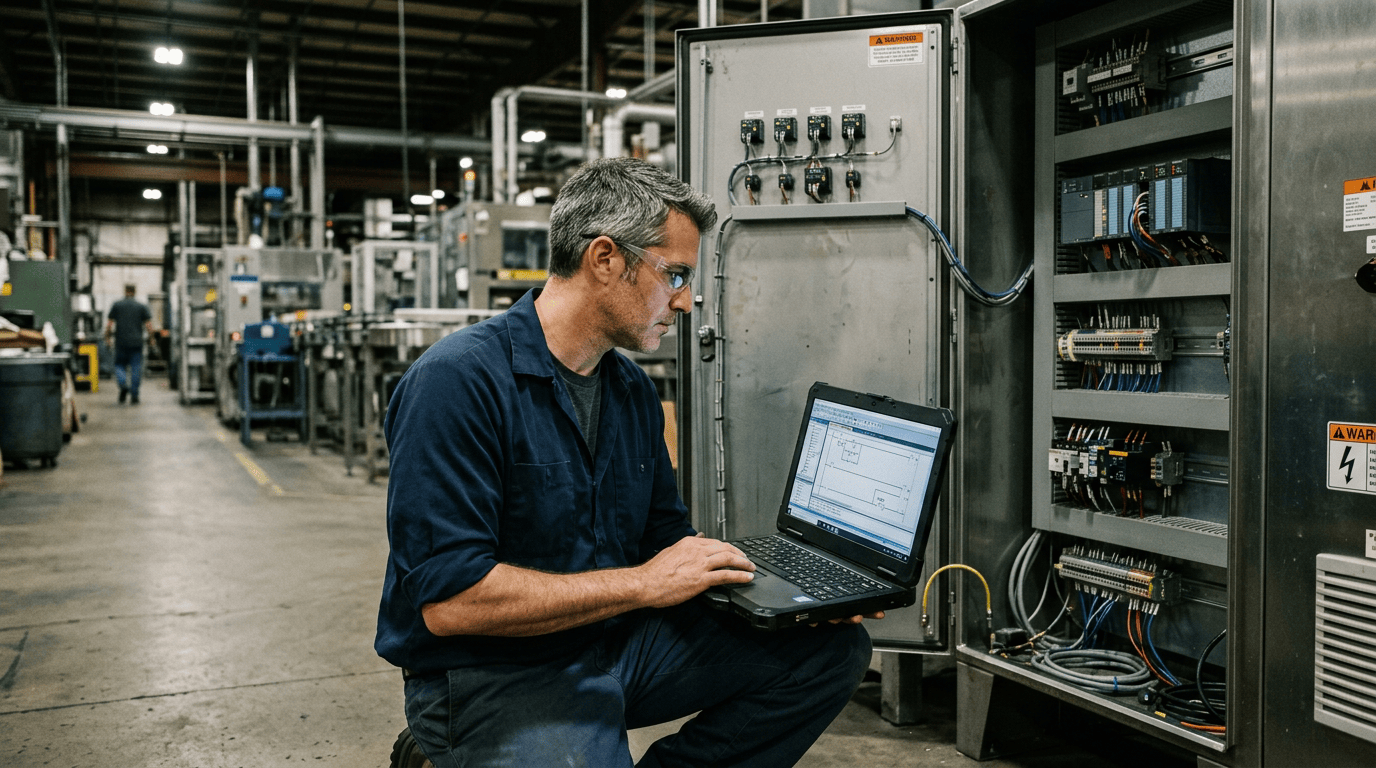
For most industrial teams, understanding software-defined automation starts with a frustration they already know: control logic that is frozen in hardware. A setpoint change requires an on-site engineer. A strategy update means touching each facility individually. A new operational standard takes months to propagate across a 20-site portfolio because every location runs a slightly different configuration of the same equipment.
Software-defined automation changes the underlying premise. Instead of embedding control logic directly into proprietary hardware, the software layer governs what machines do, how they behave, and how they respond, independently of the physical devices executing those instructions.
The hardware still runs. The equipment still matters. But the intelligence that directs it lives in software, which means teams can update, govern, version, and deploy it at scale, giving companies greater flexibility to adapt without being locked to rigid hardware upgrade cycles. Technical as the distinction sounds, the operational consequences are not.
The Core Idea: Separating Control Logic from Hardware
Traditional industrial automation binds control logic to the hardware running it. The program lives in the PLC. The configuration lives at the site. The strategy is shaped by whoever commissioned that specific machine, years or decades ago. When that person leaves, the logic goes with them.
Software-defined automation decouples those layers. Control software runs on a platform, not inside a piece of proprietary hardware. That platform connects to physical devices on the plant floor through edge computing, and receives governance, updates, and intelligence from the cloud.
The result is a system architecture where the logic that drives industrial operations can often evolve without requiring physical changes to equipment, depending on system constraints and safety requirements, and where the industry can create scalable, future-ready workflows and solutions that compound in value rather than stagnate.
The technologies enabling this have matured to the point where industrial teams no longer need to rebuild from scratch to move forward, and control logic updates can be staged, validated, and deployed portfolio-wide through a single system interface, with version control and site-specific overrides maintained throughout.
How Traditional PLC-Based Control Creates a Ceiling
Programmable logic controllers have been the backbone of industrial automation for decades, and they will remain part of the control landscape for decades more. The issue is not that PLCs are inadequate for executing control logic at the device level. The issue is what happens above that layer.
When control logic lives inside discrete PLC programs, each site effectively builds its own system. Alarm setpoints differ. Naming conventions vary. Strategies that work well at one location never make it to the next because there is no shared platform to carry them. Over time, each facility becomes what operators often describe as a "snowflake," running on the institutional knowledge of whoever set it up, and a configuration nobody fully understands anymore.
The ceiling shows up when organizations try to move faster. Traditional PLC-based systems can execute control at the device level, but they were not designed to govern it at the portfolio level. The system running at site A has no connection to the system running at site B, and when something goes wrong, the system of record is whoever picks up the phone. That complexity compounds across multi-vendor environments where manufacturers run mixed OEM equipment with no shared operational foundation. That is the gap software-defined automation addresses.
How Software-Defined Automation Works
The mechanics of software-defined automation follow a consistent pattern across industrial applications, even when implementations vary.
Step One: The Edge Layer
Industrial edge devices connect directly to your existing equipment on the plant floor, whether that's process machinery, refrigeration systems, or production-line controls. These edge devices read sensor data in real time, execute control instructions locally, and maintain continuous communication with the platform above them. The industrial edge layer operates with low latency and doesn't depend on a cloud connection to keep machines running safely.
Step Two: The Software Platform
Control logic, operational strategies, alarm configurations, and governance rules live in the platform, not in the hardware. Engineers write code, test, and validate changes through structured workflows and repeatable processes. Digital twins let your team simulate how a change will behave before deploying it to live equipment, protecting production continuity.
These digital twins are among the most underused tools in industrial development, precisely because existing control environments never had a layer where safe simulation and automated testing were possible. Modern automation systems that support this kind of pre-deployment validation give teams the capabilities to innovate without the downside risk of unplanned production disruption.
Step Three: Governed Deployment
When a change is ready, it deploys across target sites through the platform rather than through manual site visits. Role-based access controls determine who can initiate changes, who must approve them, and what the audit trail looks like. The platform tracks every modification with full traceability, giving users and leadership a complete audit record across all sites.
Step Four: Continuous Improvement
New capabilities, updated control strategies, and refined optimization logic reach your entire portfolio as the platform evolves. There's no separate upgrade project at each site. Improvement compounds, and enterprises can accelerate innovation across their portfolio without resetting processes at every location.
The technologies enabling this, cloud connectivity, industrial edge compute, and AI, are built for interoperability across mixed-vendor environments. Platform integration becomes the foundation for future capability, not a one-time deployment event.
The Role of Edge Computing in Software-Defined Automation
Edge computing is the execution layer that makes software-defined automation practical in industrial environments. Industrial edge devices are where sensor data becomes actionable, where control instructions meet physical machines, and where real-time decisions happen without waiting for a round-trip to the cloud.
In a software-defined architecture, the industrial edge and the cloud platform are complementary layers, not competing ones. Industrial edge devices handle the low-latency, safety-critical execution that plant floor operations demand. The cloud platform handles governance, analytics, and portfolio-wide deployment. Edge computing also reduces reliance on centralized servers for time-sensitive decisions, improving both reliability and performance at the facility level. For a closer look at how that split works and which workloads belong where, see this guide to edge vs. cloud analytics for industrial equipment.
PLC vs. Software-Defined Automation: What's Actually Different?
PLC vs software-defined automation is a comparison that often generates more confusion than clarity, because the two aren't mutually exclusive. PLCs are hardware controllers. Software-defined automation is an architectural approach. In most real-world deployments, the PLCs stay in place. The software-defined layer sits above them.
The meaningful difference is in where control logic lives, who can change it, and how fast your organization can act.
Matt Jones, President and CEO at Innovative Cold Storage, described the shift from manual PLC controls to intelligent systems as going from a typewriter to a computer. The underlying task is the same. The speed, flexibility, and capability are in a different category entirely.
The industrial automation market is already moving in this direction. According to IoT Analytics' Industry 4.0 and Smart Manufacturing Market Report, the global smart manufacturing market reached $175 billion in 2025, with leading vendors, including companies like Schneider Electric, prioritizing software-defined, artificial intelligence-infused architectures as the foundation for future industrial automation solutions. Across the industry, manufacturers are looking for system-level approaches that create consistent performance without requiring uniform hardware at every site.
What Software-Defined Automation Makes Possible for Industrial Teams
For manufacturers and enterprises managing multi-site portfolios, software-defined automation delivers three categories of operational improvement.
The proof shows up in the field. Nick Green, Senior Manager of Refrigeration and Engineering at Americold, oversaw the consolidation of more than 20 different control systems into a single platform. The results included $600,000 in savings during a major heat wave event, driven by coordinated portfolio response rather than site-by-site management.
At Lineage, Erik Krupa described managing nearly 480 facilities globally where no two are the same. The ATLAS Enterprise Control Platform (ECP) delivered a "common look and feel" across control systems and energy savings of 20-30% at facilities, exactly what software-defined automation is designed to produce: a governed standard that scales across heterogeneous infrastructure without requiring uniform hardware.
Why Legacy Equipment Is Not a Barrier
One of the most persistent objections to software-defined automation in heavy industry is the assumption that it requires new hardware. Most industrial facilities run equipment that is 10, 20, or 40 years old, with no budget or operational tolerance for rip-and-replace.
Software-defined automation sits on top of existing infrastructure. The edge layer connects to the PLCs, sensors, and OEM systems already in place. The platform creates a common operating model across that mixed equipment environment without requiring hardware upgrades. Legacy systems stay active and productive. Users at every level gain visibility and control capability without waiting for a capital replacement cycle.
Rather than treating each site as a separate automation systems project with its own costs and commissioning effort, teams deploy a shared platform model that improves in performance as it scales. Production environments benefit most: improvement happens in the background rather than requiring scheduled downtime.
The Governance Dimension Most Teams Miss
Most conversations about software-defined automation focus on speed: faster updates, easier deployments, greater scalability. Those benefits are real. But the governance dimension is what separates an architecture your engineering leadership can rely on from one that creates new risks while solving old ones.
Governance in a software-defined environment means three things:
- Every change carries an audit trail. Who initiated it, who approved it, when it deployed, what changed.
- Access is permissioned. Role-based controls determine which engineers can modify which systems and at what scope.
- Monitoring becomes proactive. Not just watching what happens, but having confidence in what prevents it.
ISA/IEC 62443, the leading international standard for industrial automation and control system security, defines shared responsibility across asset owners, integrators, and technology providers as a foundational principle. Software-defined architectures centralize change management rather than distributing it across disconnected site-level systems, which positions them well to meet that standard.
The question to ask isn't just "can we update control logic faster?" It's "can we prove what our systems are doing, why, and who authorized it?"
Software-defined automation, built on a proper governance model, makes that answer a “yes”. The tools and interoperability standards that enable audit-ready governance are mature enough today that your team can create flexible governance solutions without choosing between speed and accountability.
Industrial DevOps practices, digital twin testing, and role-based access aren't future capabilities. They're available now, and the organizations building on them are pulling ahead.
Challenges Industrial Teams Should Plan For
Software-defined automation creates real capability gains alongside real implementation considerations.
IT/OT Integration
Connecting OT environments to cloud-connected platforms requires careful security architecture. Cybersecurity standards like ISA/IEC 62443 exist precisely because OT environments carry different risk profiles than IT systems. Any software-defined implementation should address network segmentation, access controls, and data handling explicitly. Most teams start from the Purdue Model's separation of OT and IT, using the DMZ between site operations and business systems as the boundary to design around.
SOC 2 compliance from the platform provider matters for data security hygiene, but it is not a substitute for OT-specific security architecture. The certification tells you how a vendor handles data - the architecture tells you whether the implementation is safe to run alongside live industrial equipment.
Change Management
This isn't a technology deployment. It's an operational change. Your engineers need to trust the system before they rely on it. Operators need visibility into what the platform is doing and why. Teams that treat it as a portfolio-wide transformation, with structured rollout, operator training, and ongoing support, build durable results.
See how industrial operations teams have made this transition across real multi-site portfolios.
Industrial DevOps Practices
As control logic moves into a managed software environment, your team benefits from applying software development disciplines: version control, automated testing, staged deployment, and rollback capability.
Industrial DevOps brings these flexible workflows and structured code management to the plant floor, making it practical to test dynamic changes, maintain reliable processes, and deploy updates safely. Teams adopting Industrial DevOps build a meaningful competitive advantage in how quickly they can innovate and iterate, and how scalable that innovation becomes once those practices are embedded into normal production development cycles.
Planning for these challenges isn't a reason to delay. It's a reason to choose an implementation partner who has navigated them before.
The Bottom Line
Software-defined automation isn't a hardware replacement project or a monitoring upgrade. It's a decision to stop reacting site by site and start governing the portfolio as one system. The teams pulling ahead aren't the ones with the newest equipment. They're the ones that figured out how to make their existing infrastructure smarter, their operational standards enforceable, and their improvements repeatable across every site they run.
If that's the direction your organization is heading, the next step is seeing what it looks like in practice.
Talk to CrossnoKaye's industrial controls team about what a governed, portfolio-wide approach looks like for your operations.
Frequently Asked Questions
How does software-defined automation handle cybersecurity for OT environments?
Security is one of the most legitimate concerns when connecting OT environments to cloud-connected platforms, and it deserves a direct answer. Purpose-built industrial control platforms should be SOC 2 compliant, which covers data security hygiene - how your operational data is stored, handled, and protected. That's necessary, but it doesn't address OT-specific security.
Any implementation should address network segmentation between IT and OT layers, role-based access controls that limit who can initiate or approve changes, and encrypted data handling end to end. Standards like ISA/IEC 62443 exist specifically to define what secure industrial automation looks like in practice. The short answer: cloud connectivity and OT security aren't mutually exclusive, but the architecture and the platform provider's certifications matter.
How long does it take to implement software-defined automation across a multi-site portfolio?
Implementation timelines vary based on portfolio size, equipment mix, and how phased the rollout is, but a single-site pilot typically runs six to 18 months. From there, expansion to additional sites accelerates because the configuration work done at the first site doesn't have to be rebuilt from scratch.
The platform model is designed so that what works at one location can be replicated across others without treating each facility as a separate engineering project. The more important question isn't how long it takes to deploy. It's how long it takes to see results, and for most teams that begins well before the full portfolio is live.
Is software-defined automation the same as SCADA?
No. SCADA systems provide supervisory visibility and data collection, typically with limited control authority. Software-defined automation goes further: it enables control logic itself to be defined, updated, and governed in software, independent of the underlying hardware. A SCADA system can tell you what is happening. A software-defined control platform can change what happens, deploy updated strategies at scale, and enforce consistent standards across a multi-site portfolio. Modern software-defined platforms often sit above or alongside SCADA infrastructure rather than replacing it.
Ready to see software-defined control working at scale? Talk to CrossnoKaye's industrial controls team about what a governed, portfolio-wide automation approach looks like for your operations.

Stay Connected
Subscribe to stay in the loop on the latest industry news.
Related Posts
.png)