Industrial Refrigeration Automation: Enterprise Controls Guide
A practical guide to industrial refrigeration control automation for enterprise operators — covering portfolio-wide deployment, governed control, and how to scale without rip-and-replace.
Industrial refrigeration control automation has become the dividing line between operators who run a portfolio as one governed system and those who manage a collection of one-off plants. At a single facility, automated control looks simple: add temperature sensors, tune setpoints, and let the control logic hold temperature.
Across 20 or 200 refrigerated sites, the same approach turns messy. Each plant ends up with its own control systems, its own alarm definitions, and its own operator workarounds, and the knowledge of how those systems run lives in whoever answers the phone.
This guide looks at industrial refrigeration through an enterprise lens: what automated control involves, why it stalls between the first site and the fiftieth, and how leadership teams standardize these systems without ripping out the equipment already running.
What Is Industrial Refrigeration Control Automation?
At its core, it is the use of software and connected control systems to operate refrigeration equipment automatically, holding temperature and pressure within safe limits while adapting to real-time data.
The control logic runs the plant's core functions:
- Sequences compressors, condenser fans, and pumps
- Manages floating head pressure
- Runs hot gas defrost across the entire refrigeration system
- Trips alarms when readings drift out of band
Mature systems do more than observe. They execute control decisions inside the plant, then log what changed and why.
That execution point matters. Many refrigeration systems marketed as automated are closer to monitoring systems: they collect data, surface a reading, and wait for a person to act. True control automation in industrial refrigeration closes the loop, taking the calculated next action within guardrails the team approved. Done well, it provides peak efficiency across the entire refrigeration system.
Why Single-Site Control Systems Stall at the Portfolio Level
Automated control stalls across an industrial refrigeration portfolio for one reason, and it is rarely the technology at any single plant. It is that no two sites are the same.
A facility built a decade ago runs different control systems, different naming conventions, and a different control panel layout than the site acquired last year. The SCADA screens differ, and best practices stay trapped at one site as tribal knowledge. The first sign of a problem is often a 2 a.m. call rather than an early warning.
Leadership feels this as blind spots. Operations leaders are accountable for safety, compliance, and energy spend across every site, yet they depend on inconsistent reporting from systems that do not speak the same language. Automating one plant well does not fix that. It widens the gap, creating one optimized site in a portfolio of systems still running on hunches.
The Building Blocks of Automated Refrigeration Systems
Automated industrial refrigeration systems share a common set of components, whatever the brand of equipment underneath, and the control systems running them vary by site. Knowing these components clarifies where the platform adds value and where governance and efficiency gains come from.
From the Control Panel to the Cloud
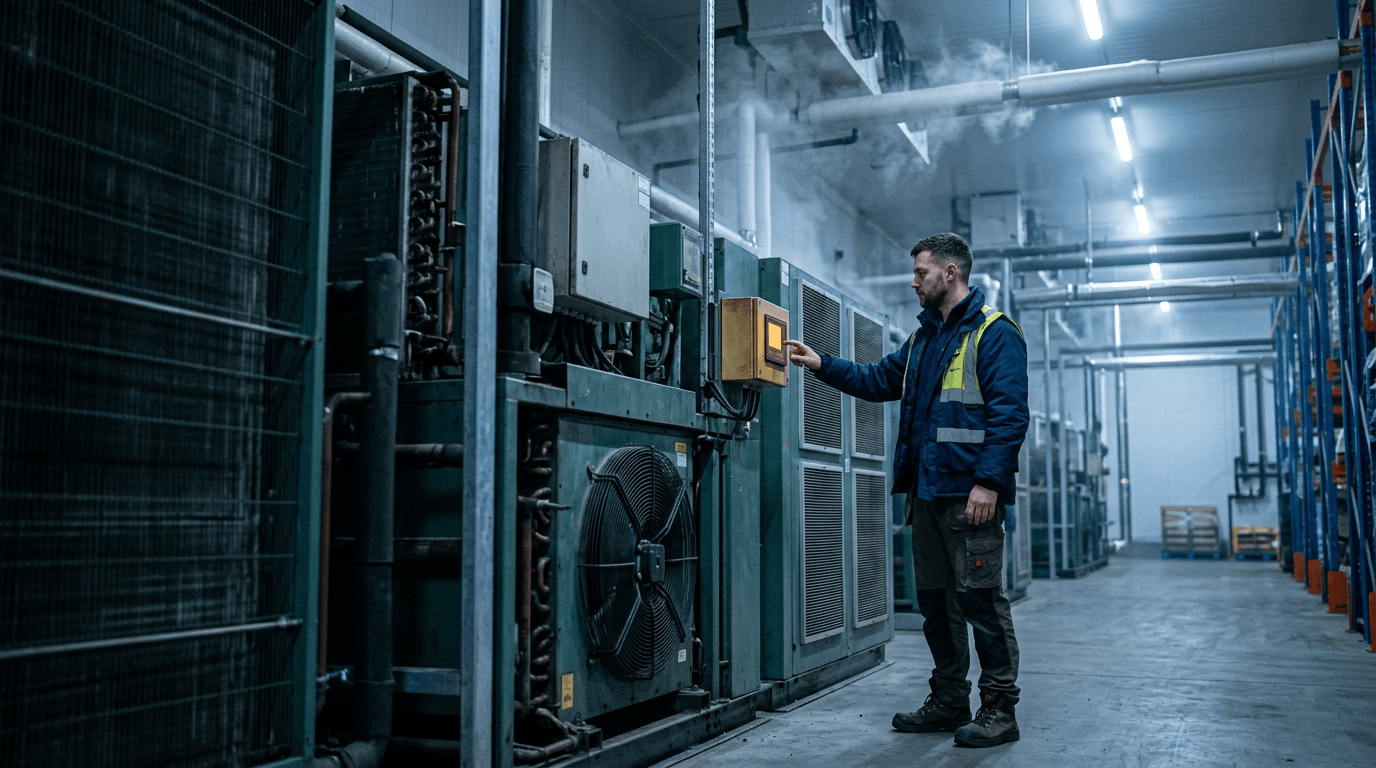
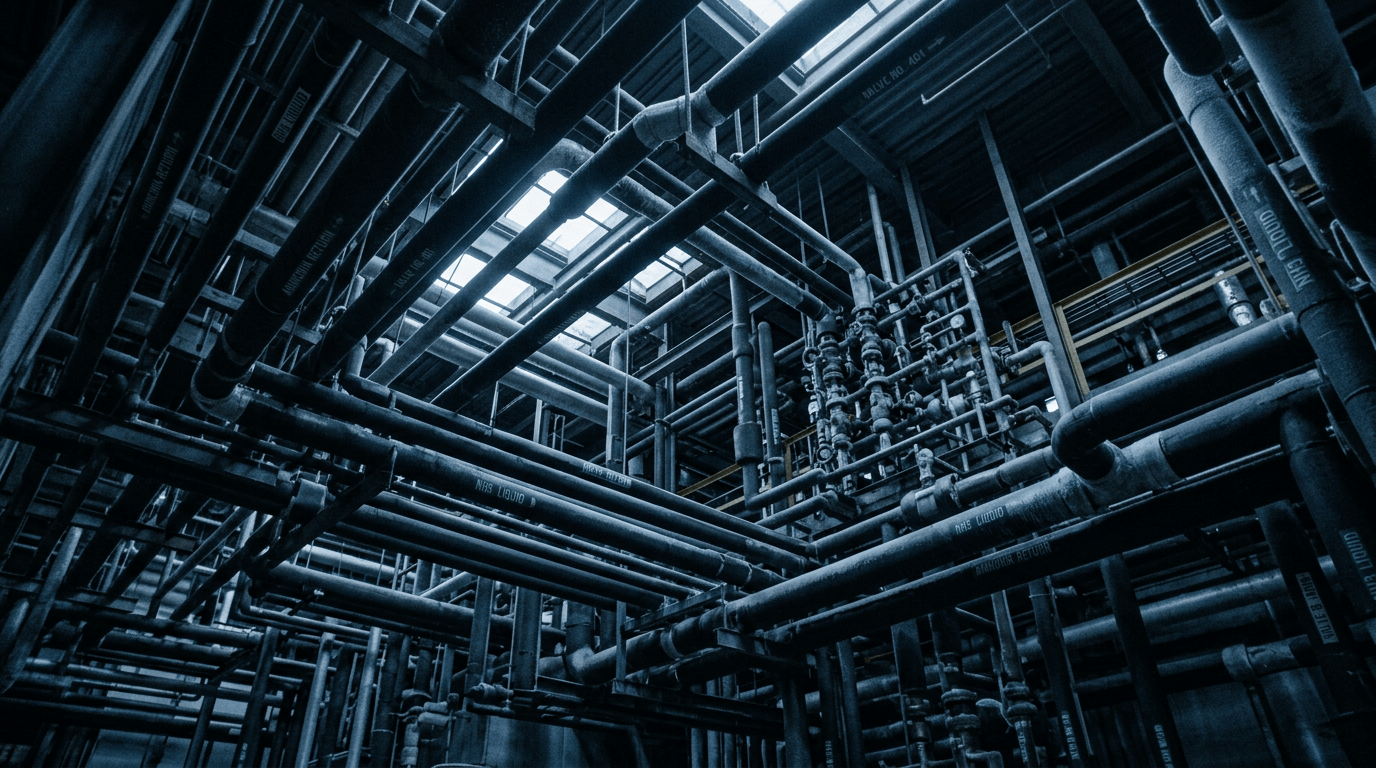
At each site, a control panel and its programmable logic controllers govern the machinery: compressors, condensers, evaporators, pumps, fans, and supporting components. That control panel is the local source of truth, wired to temperature sensors and pressure transducers for data acquisition across the plant. That arrangement mirrors the lower levels of the Purdue Model, where sensors and actuators sit beneath the PLCs running the control logic.
Its limitation is reach. A control panel runs one site well, but it was never built to share state with the 20 other control panel installations across the country. Connecting each control panel to a common platform provides leadership a single view of every site's systems and turns isolated monitoring into portfolio monitoring.
Remote Access and Real-Time Detection
Connecting each site control panel to the cloud gives teams permissioned remote access to live operations and real-time data from anywhere, an architecture built on the same Industrial IoT (IIoT) foundations used across modern refrigeration fleets. Instead of dispatching an engineer to read a panel, the on-call team views the same system state remotely, spots an abnormal pattern in the real-time data, and coordinates the fix.
Continuous monitoring runs beneath all of it. The platform provides round-the-clock monitoring and alerts operators when readings drift. It does not schedule the maintenance, which keeps human judgment in the loop on every action.
From Monitoring to Execution: What Governed Control Means
Governed control is the difference between a platform that shows a problem and one that can safely act on it. In a governed model, leadership sets the standards (setpoints, alarm taxonomy, safety boundaries) and sites execute within them.
That is what separates enterprise industrial monitoring from real control authority.
Permissioned access makes operators comfortable with it. Site teams keep the autonomy to operate their plant, while corporate gains the visibility to compare performance and roll out improvements once rather than rebuilding them site by site.
Connected systems provide every team the same operational context. Strong governance is what lets reliable, governed control scale safely, protecting site safety while holding performance and uptime steady across the portfolio.
Request a demo to see governed control across your portfolio.
Automating Industrial Refrigeration Without Rip-and-Replace
The most common objection to modernizing industrial refrigeration is cost and disruption, the assumption that change means tearing out working equipment. It does not have to. A platform layer connects to the existing control panel hardware and OEM controls already running each site, normalizing their different tags and units to create one common operating model. This is a defining shift for the industry.
That approach lets a portfolio standardize without a capital project at every facility. New control strategies deploy across these systems from the cloud to ensure improvements compound instead of resetting. The ATLAS enterprise control platform adds intelligence on top of existing refrigeration systems rather than replacing them.
Measuring the Payoff: Energy Usage, Labor, and Reliability
The payoff from refrigeration control automation is easiest to see in energy usage, where the savings run largest. Refrigeration accounts for more than two-thirds of a refrigerated facility's electricity use, and continuously tuned control has delivered an average 21% reduction in energy cost across deployments — for the full breakdown of what drives that spend, see the Complete Guide to Cold Storage Energy Management. According to research presented to the American Council for an Energy-Efficient Economy. Across the industry, it is typically the second-largest operating cost after labor. Continuously tuned control has delivered an average 21% reduction in energy cost across deployments, lowering spend and improving efficiency.
Labor and reliability follow. Teams that diagnose and resolve issues remotely cut costly truck rolls, with some operations seeing 50% fewer contractor dispatches. The data from each site feeds back into portfolio performance, lowering after-hours emergencies and protecting both product and compliance. For a closer look at the energy side, see this guide to industrial energy management at scale.
Contact CrossnoKaye to model the payoff for your sites.
What Enterprise-Scale Refrigeration Automation Looks Like in Practice
At enterprise scale, the goal is a common look and feel across every site. Lineage Logistics runs close to 480 facilities where, in the words of its engineering leadership, no two are the same. ATLAS deployment gives those refrigeration systems a shared operating model that improves efficiency and has produced savings of 20 to 30%.
US Foods describes a similar shift in how it handles demand response. Rather than sending staff on-site to manage each event, the work now runs hands-off across facilities through one platform.
In both cases, the pattern is the same. Control automation stops being a per-plant project and becomes a portfolio-wide capability that the whole operation and its systems can rely on, and the industry is adopting it fast.
Frequently Asked Questions
How long does it take to roll out refrigeration control automation across a portfolio?
A single-site pilot is typically proven first, then expanded across the portfolio. Because the platform layers onto existing control systems rather than replacing them, expansion across additional sites moves faster than the initial deployment, since the standards, alarm logic, and control strategies are already built.
Is cloud-connected refrigeration control automation secure enough for critical operations?
Yes, when the platform meets enterprise security standards. A SOC 2 compliant platform with encryption, single sign-on, and a full audit log provides that protection, and the local control panel retains manual override so a site keeps running if the connection drops.
Can refrigeration control automation work with both ammonia and CO2 systems?
Yes. Automated control operates on top of the existing control systems regardless of refrigerant, including ammonia and CO2 refrigeration systems, and it respects the ammonia refrigeration safety standards that govern safe design and operation. That keeps the work reliable and the entire refrigeration system within compliance.
Ready to standardize control automation across your refrigerated portfolio? Request a demo or contact CrossnoKaye.
Stay Connected
Subscribe to stay in the loop on the latest industry news.
Related Posts
.png)