When Energy Costs Shift, Your Cold Storage Facility Should Respond
How ATLAS uses software-defined automation and intelligent control to help cold storage facilities dynamically reduce energy costs—without compromising product, equipment, or operator authority.
The flexibility was always there.
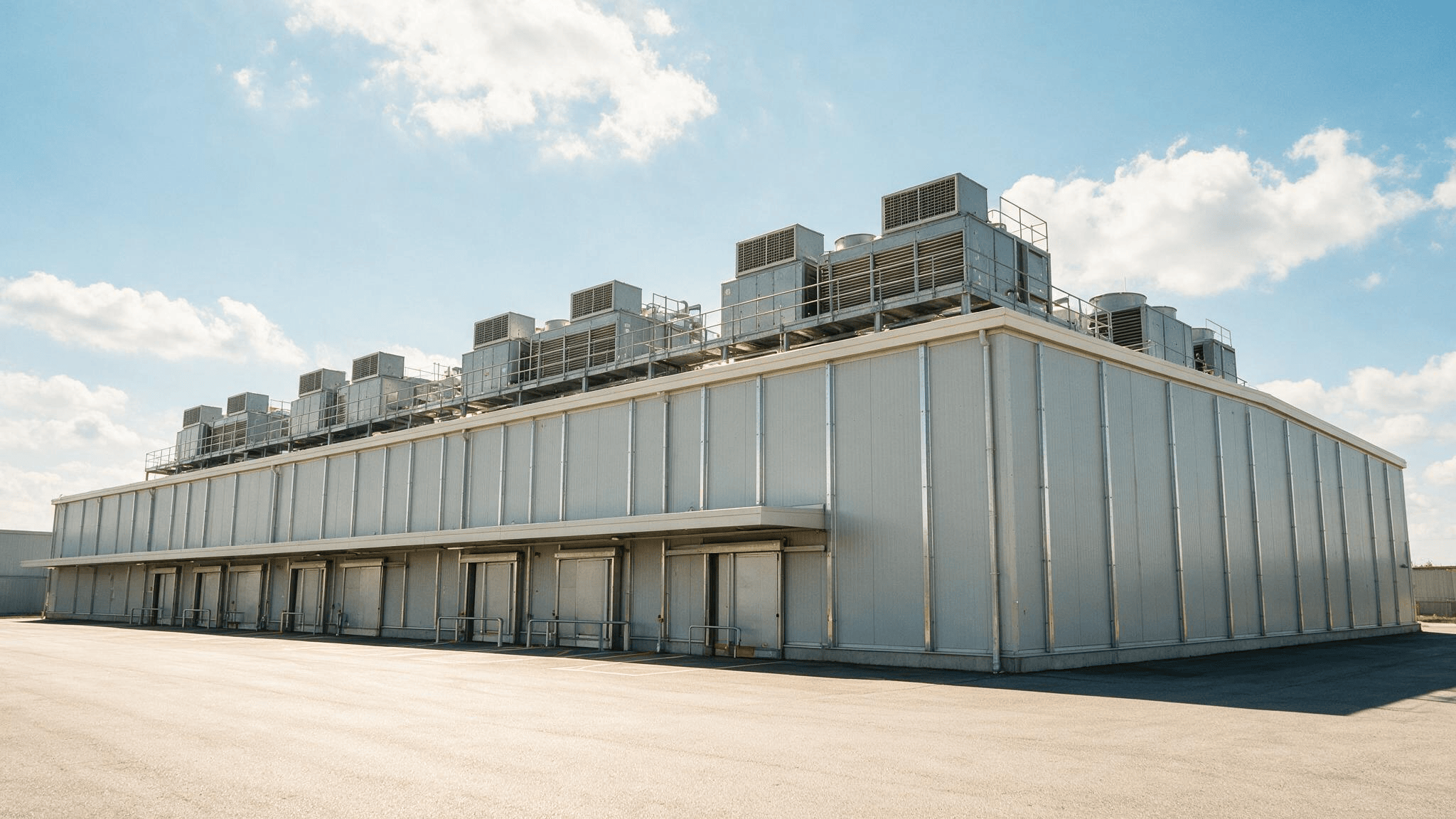
Cold storage is one of the few industries where the facility itself can act like a thermal battery.
A refrigerated warehouse holding thousands of pallets at -10°F contains enormous thermal mass. Pull temperatures down when energy is less expensive, and the facility can coast through a more costly window before compressors need to return to normal operation.
Cold storage operators have known this intuitively for decades. What most facilities have lacked is a safe, repeatable way to turn that thermal flexibility into an operating strategy—especially across an entire portfolio.
The reason isn't a lack of will. It has been the difficulty of executing at exactly the right moment without putting product, equipment, or operations at risk.
That was the constraint. And ATLAS changes it.
By bringing software-defined automation and intelligent control to industrial refrigeration, ATLAS connects what is happening inside the facility with what is happening outside it. Weather forecasts. Grid conditions. Energy prices. Tariffs. Production schedules. Equipment and renewable conditions. Temperature requirements.
ATLAS continuously interprets those conditions and adjusts the control strategy inside operating boundaries defined by the facility team.
That capability matters because energy markets have become dynamic. Most refrigeration control systems have not.
The grid changed. Most control systems did not.
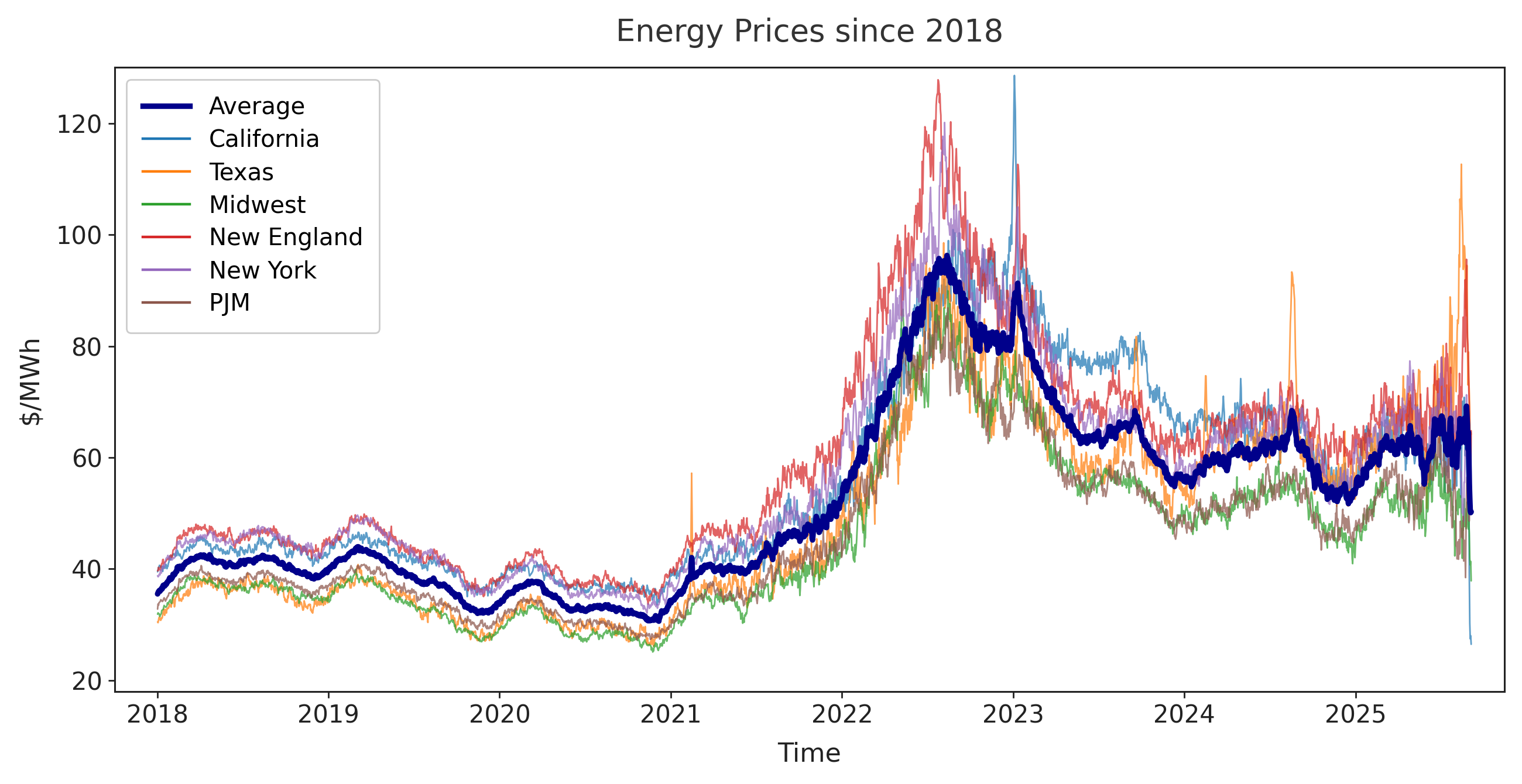
The energy environment cold storage facilities operate within has become more volatile, more constrained, and less predictable.
Across ERCOT, CAISO, NYISO, MISO, ISO-NE, and PJM, electricity markets have followed different paths. But the broader direction is consistent: energy prices are moving more sharply, and the financial consequences of consuming power at the wrong time are growing.
At the same time, electricity demand is arriving in larger, more concentrated blocks. Extreme weather, data-center growth, electrification, and changing generation patterns are placing new pressure on regional grids.
The result is not simply a busier grid. It is a less forgiving one.
For cold storage facilities, the greatest exposure is often concentrated in a relatively small number of critical hours: the hottest afternoons of summer, periods of extreme winter demand, or moments when regional capacity and transmission systems approach their limits.
Plans that work on an ordinary day become harder to execute, precisely when the financial stakes are highest. During those windows, one missed event can undo months of incremental energy efficiency gains.
Most refrigeration control systems were designed to respond to conditions inside the facility, not to continuously interpret weather forecasts, grid demand, energy prices, tariff structures, facility schedules, and equipment conditions—and then change the operating strategy before the financial event arrives.
That creates a growing mismatch for teams operating on traditional controls systems. Energy prices move dynamically. Many facilities are still operating through fixed setpoints, static schedules, site-specific control logic, and manual curtailment plans.
The problem is not awareness. It is execution.
Executing a coincident-peak response asks one person to be a grid analyst, energy trader, controls engineer, refrigeration operator, and risk manager at the same time.
They must interpret the forecast, determine when to pre-cool, decide how far temperatures can safely move, identify which equipment can be curtailed, act at precisely the right moment, and recover without creating a rebound peak or placing unnecessary stress on the system.
Then the forecast changes.
And so do the variables they need to consider.
Weather shifts. Grid demand rises faster than expected. Production schedules move. A blast freezer comes online. Equipment conditions change. What appeared to be the right strategy an hour ago may no longer be the right strategy now.
Across a portfolio, the challenge multiplies.
Each facility has a different equipment mix, tariff, operating schedule, thermal profile, product load, and risk tolerance. The same regional event may require a different response at every site.
And it is often happening during the hottest part of the day, over a weekend, or while teams are already managing the conditions that created the event in the first place.
This is not a knowledge problem. Experienced operators understand their facilities.
It is a coordination and execution problem—one that has outgrown what any person or shift can reasonably monitor, calculate, and act on in real time.
When one signal is missed or one decision comes too late, a facility can carry the cost of that hour for the rest of the year.
The teams doing this manually deserve better tools.
Operations teams across the country are already working tirelessly to manage these events.
The savings they create through discipline, communication, and sheer effort are real. They deserve credit for it.
They also deserve technology that does not require heroic coordination every time the grid becomes constrained.
The goal is not to replace operator knowledge or take control away from the people responsible for the facility. It is to stop consuming their judgment on continuous monitoring and coordination work that software can perform more consistently.
The team should define what safe operation looks like.
The system should help carry it out.
Software-defined automation changes the operating model.
Working with ATLAS does not mean handing a facility over to a black box.
Operators define the operating envelope: temperature bands, equipment limits, operational priorities, production requirements, and the conditions under which the system is permitted to act.
ATLAS carries out the continuous work inside those boundaries.
It monitors changing grid and facility conditions. It determines when the building should be pre-positioned. It adjusts refrigeration strategy as conditions evolve. It executes at the moment that matters. And it brings the system back in a controlled sequence.
The team can see what is happening, understand why it is happening, and intervene when needed.
The difference is not less control. It is less coordination, less vigilance, and less pressure on people to get every decision right within a narrow and constantly changing window.
That is the promise of software-defined automation: the control strategy is no longer trapped inside rigid, site-specific logic. It can adapt as energy conditions, facility conditions, and business priorities change.
And it can bring new intelligence to existing facilities without requiring a wholesale rip-and-replace.
Pre-position. Curtail. Recover.
The chart below shows a real cold storage facility running ATLAS during a predicted coincident-peak event.
.png)
ATLAS did not wait for the peak to arrive and react.
It forecasted the risk and proactively prepared the facility for what was coming.
Pre-position
Ahead of the predicted event, ATLAS increased refrigeration activity above the facility’s normal baseline.
That increase was intentional. The system was storing thermal capacity inside the building so that refrigeration demand could be reduced during the costly event window without allowing temperatures to move outside approved limits.
Curtail
As the peak window approached, ATLAS reduced refrigeration power from approximately 1,200 kW to roughly 25 kW.
The facility was able to coast on the thermal capacity created during pre-positioning while avoiding approximately 1 MW of demand during the critical window.
Recover
Once the event passed, ATLAS did not simply turn everything back on at once.
It brought the system back online in the appropriate sequence—low side first, followed by the high side—so recovery was controlled rather than chaotic.
That sequencing matters. A poorly managed recovery can create a rebound peak, place unnecessary stress on equipment, or erase part of the financial benefit created during the shed.
One site. One hour. $121,000 protected.
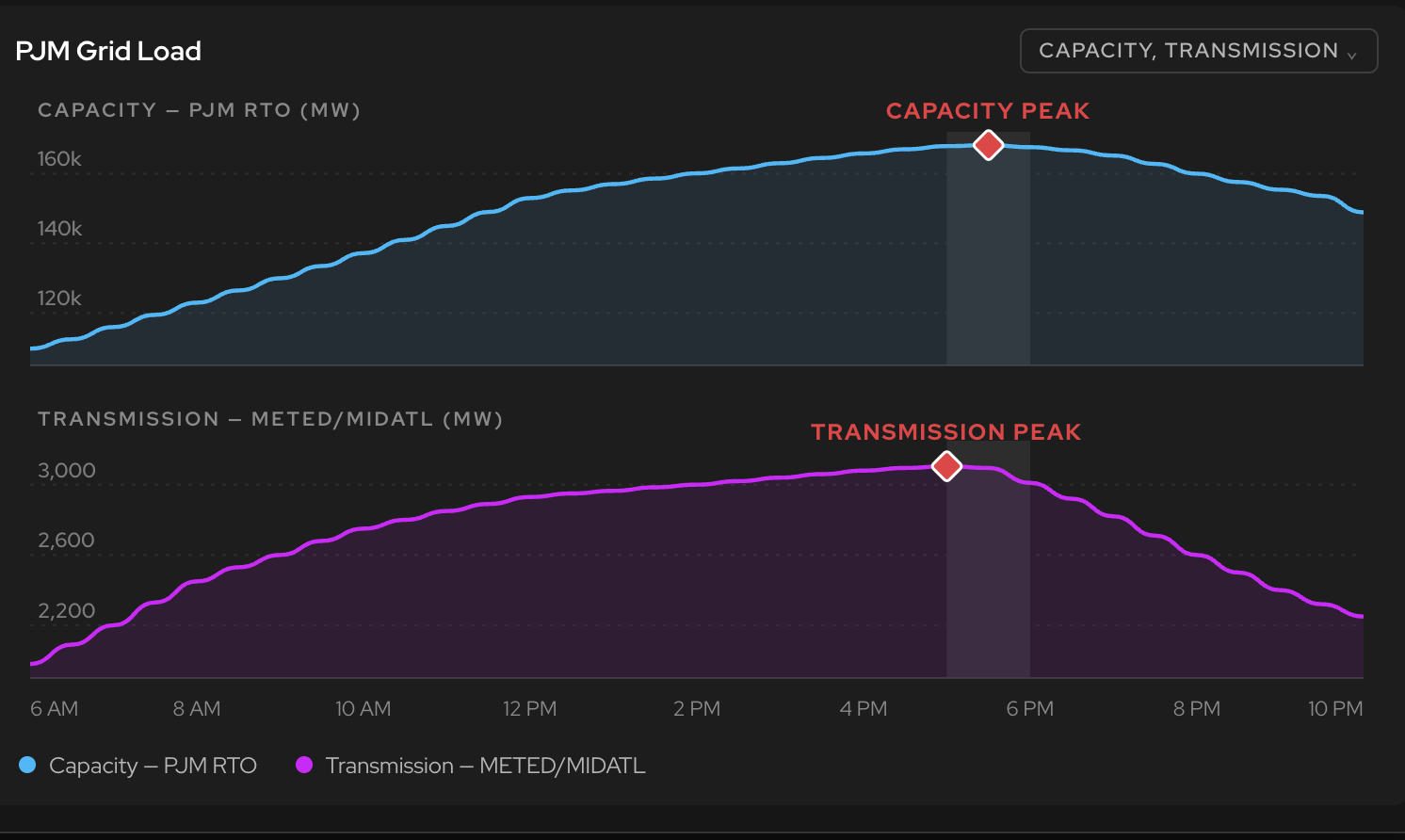
During this event, PJM’s capacity and transmission peaks occurred within the same hour.
A facility that continued operating at its normal demand through that window would have been exposed to both cost mechanisms.
Instead, ATLAS pre-positioned the building, reduced approximately 1 MW of demand during the event, and recovered without requiring an operator to manually coordinate the response.
The estimated result:
$121,000 in capacity and transmission costs avoided during a single hour at a single facility.
That number is powerful. But the larger story is how the result was created.
It did not depend on someone watching multiple dashboards throughout the afternoon.
It did not depend on a phone tree reaching every person at exactly the right time.
It did not depend on the most experienced operator being on shift.
It came from an intelligent control system that could understand changing conditions and dynamically adjust its operating strategy within the limits the facility had already approved.
One site proves it. Portfolio scale compounds it.
A single-site response demonstrates the technology.
Portfolio coordination demonstrates the operating model.
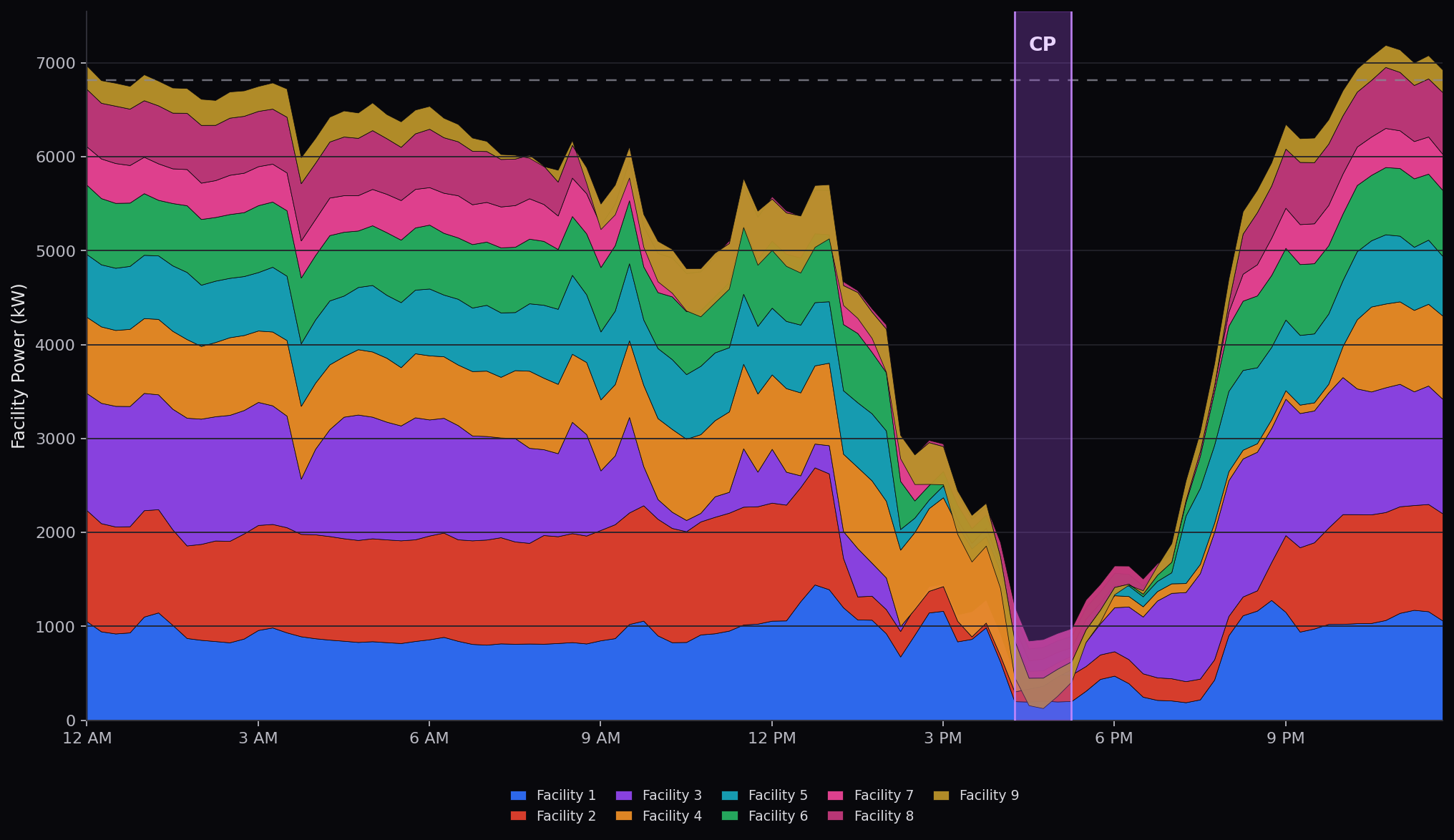
The portfolio view above represents multiple cold storage facilities operating within the same regional market.
Each facility has its own equipment mix, tariff, thermal profile, production requirements, and operating constraints.
ATLAS does not force every site into the same curtailment plan.
It evaluates each facility’s individual operating envelope and prepares the appropriate response for that site. One building may have more thermal capacity available. Another may have an active blast schedule. Another may have equipment limitations that narrow what can safely be curtailed.
No two facilities need to respond in exactly the same way.
That is the point.
The portfolio receives a coordinated result without requiring one person to manually calculate and direct every action at every site.
And the impact compounds.
One facility avoiding one peak is meaningful. Multiple facilities repeatedly responding to capacity events, transmission peaks, time-of-use windows, demand response opportunities, and real-time energy prices begins to change the economics of the entire portfolio.
Energy stops being only a cost the organization absorbs.
It becomes an operating variable the facility can actively manage.
Summer makes the value visible. Every day makes it durable.
Summer is when the value of intelligent control becomes easiest to see.
The grid becomes constrained. Peak windows become more consequential. Facilities work harder. The financial difference between responding and not responding becomes unmistakable.
But summer is not the whole story.
Most days, operating with ATLAS is intentionally uneventful.
It is the November night when ATLAS quietly adjusts suction pressure as facility load changes.
The March afternoon when it reduces exposure to an expensive rate window.
The ordinary Tuesday in October when nothing dramatic happens and the facility simply runs more efficiently than it did before.
Across the year, ATLAS can continuously tune operating conditions, stabilize demand, optimize sequencing, respond to rate signals, automate demand response programs, and reduce the amount of manual intervention required to keep the facility performing at its best.
The summer savings may be the headline.
The hundreds of days of consistent, governed execution underneath them are where the advantage compounds.
Energy is too important to manage statically
Energy is one of the largest controllable operating costs in cold storage.
And the market surrounding that cost is moving faster than conventional control strategies were designed to handle.
Cold storage teams should not have to choose between protecting product and responding to energy prices. They should not have to depend on heroic manual coordination to capture opportunities that appear for only a few hours—or a few minutes.
They should be able to define the operating boundaries and trust the system to respond intelligently inside them.
When energy prices move, refrigeration should move with them.
That is what software-defined automation makes possible.
See ATLAS live.
We will walk you through how ATLAS predicted the risk, pre-positioned the building, reduced demand, and recovered the facility in a controlled sequence.
Follow CrossnoKaye on LinkedIn for more real-world operating data, customer results, and examples of intelligent control in industrial refrigeration.

Stay Connected
Subscribe to stay in the loop on the latest industry news.
Related Posts
.png)